
Agroforestry
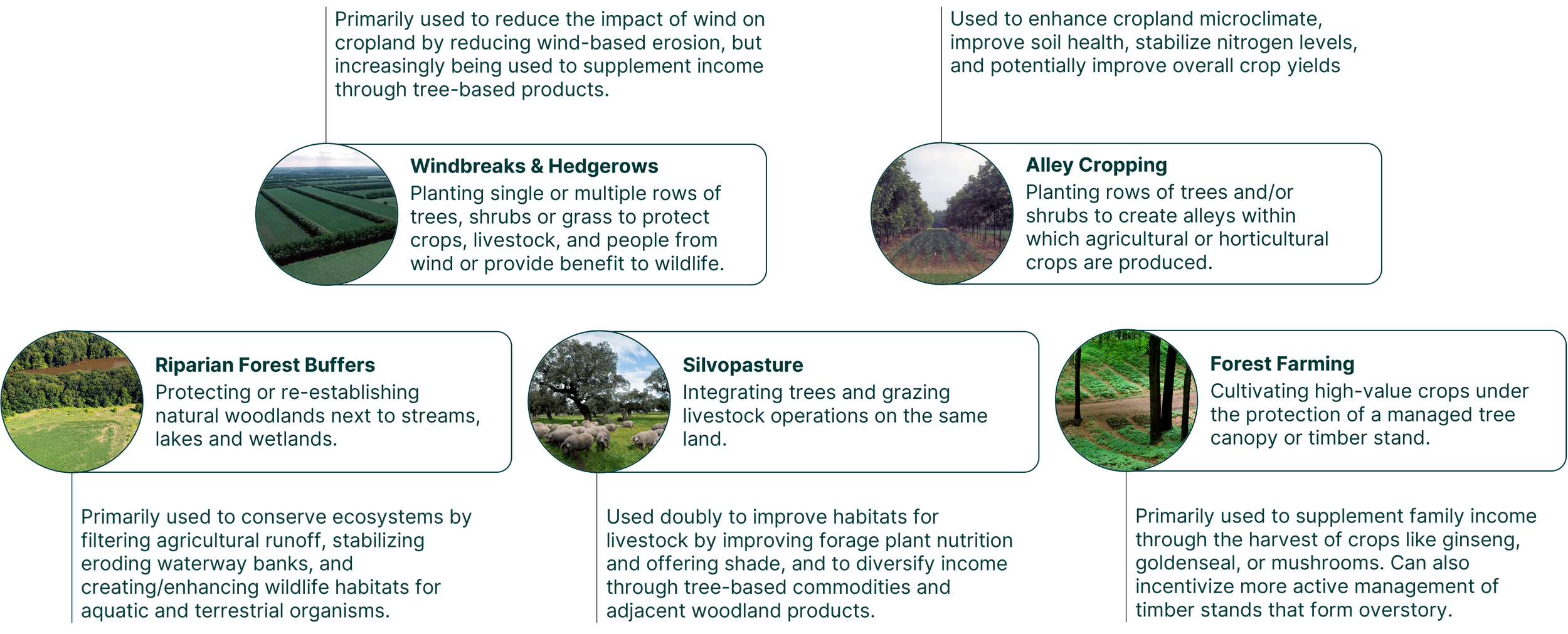
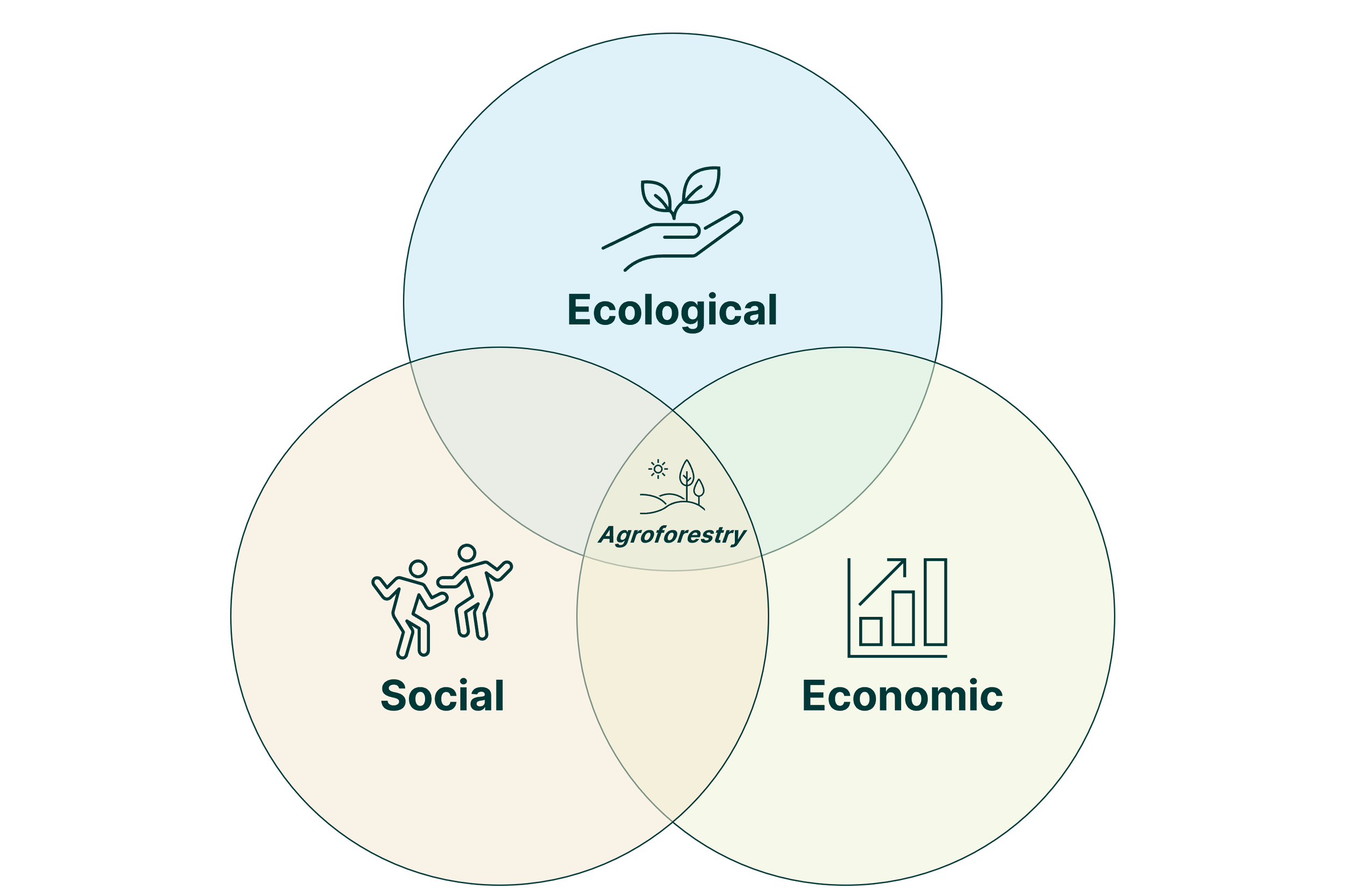
Agroforestry is the intentional integration of trees and shrubs with crops, livestock, or both. Rather than treating forestland and farmland as separate, agroforestry systems are designed so that each element supports the others — improving soil health, diversifying income, and making the land more resilient over time. For landowners across the Northeast, it represents one of the more flexible categories of emerging markets, with practices that can scale from a few acres to a full operation.
Forest Farming
Forest farming involves cultivating high-value crops beneath an existing forest canopy, working with the shade and ecosystem conditions the forest already provides. It's a low-disturbance practice that can generate meaningful income without clearing or significantly altering your land. Ginseng, shiitake mushrooms, and goldenseal are among the most established forest farming opportunities in the Northeast — and each is explored in more detail in the sections below.
Select a topic below to learn about starting and scaling a forest farming enterprise on your land:
Forest Farming Crops County Breakdown
Click a crop to see which New York counties report it. Hover any county for details.
Forest Farming Understory Crops:
Shiitake
Shiitake mushrooms are well-suited to small-scale forest farming and can generate income relatively quickly compared to other forest crops. They are typically grown on cut hardwood logs — oak being the most common — inoculated with mushroom spawn and stacked in shaded, humid areas of the forest. Local farmers markets, restaurants, and food co-ops are common outlets, making shiitake a good fit for landowners interested in direct or regional sales.
Select a topic below to learn about starting and scaling a shiitake enterprise on your land:

At a glance
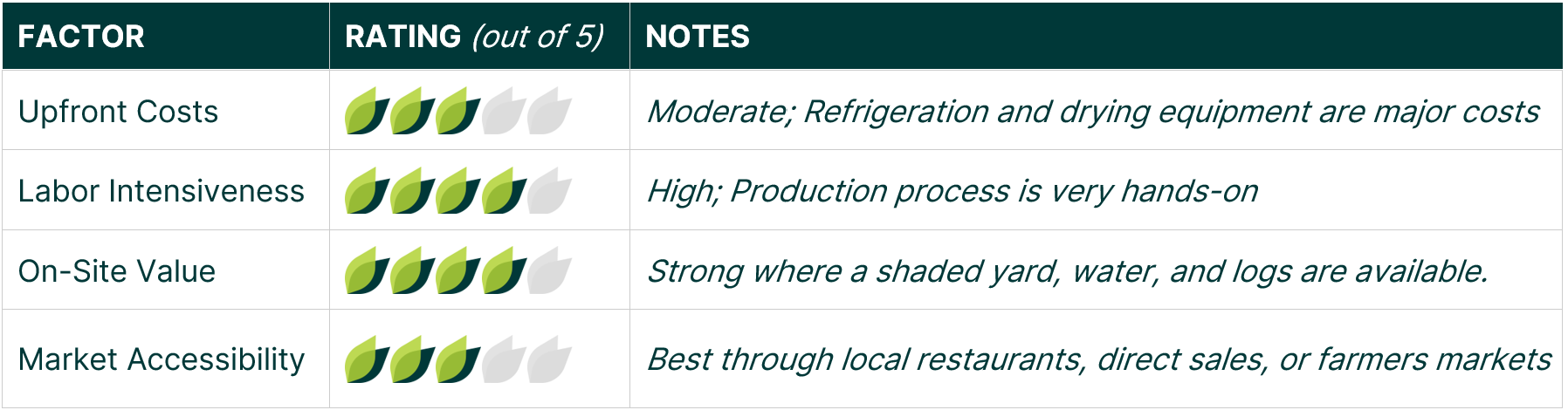
Shiitake can work well on properties with shaded hardwoods, dependable moisture, and a landowner willing to manage logs by hand.
Log-grown shiitake are slower than annual crops. Expect about 8-18 months from inoculation to first fruiting, but productive logs can keep fruiting for 3-6 years.
Best fit is as a diversified side enterprise with direct or local sales. Fresh mushrooms usually drive revenue; dried mushrooms, bolts, and spent logs can add value.
Decision Factors
Growing shiitake creates the most value when integrated with existing woodland management, utilizing culled hardwoods from routine thinning or firewood cutting. Start small to test your microclimate and labor capacity before scaling up.
Ginseng
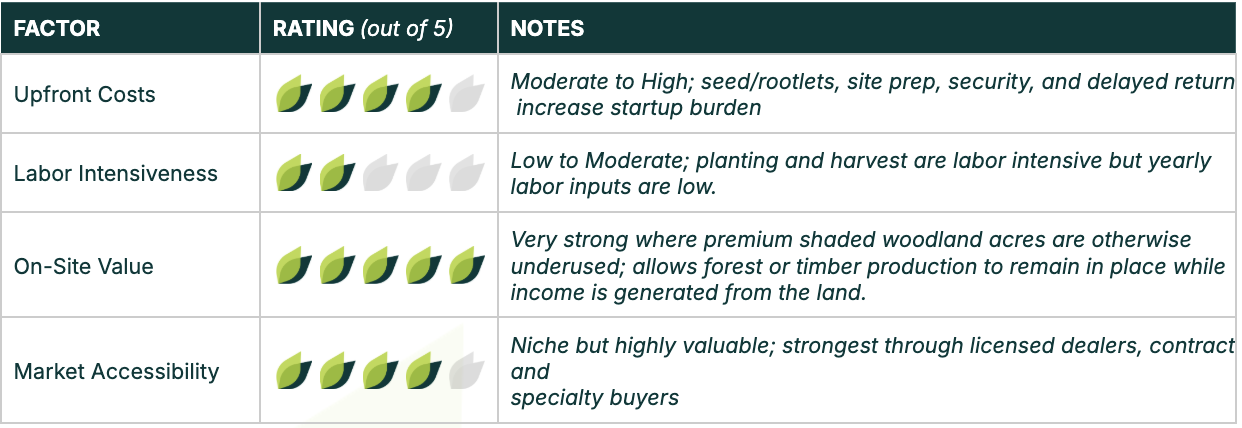
American ginseng is one of the highest-value forest crops available to Southeastern landowners, with strong and longstanding demand in both domestic and international markets. It grows well in the shaded hardwood forests common across the region and can be harvested and sold as roots, seed, or rootlets. Ginseng requires patience — roots typically take 5–10 years to mature — but the returns can be substantial for landowners willing to play the long game.
Select a topic below to learn about starting and scaling a ginseng enterprise on your land:
At a glance
American ginseng (Panax quinquefolius) is native to the U.S. and can work well in select Northeast forest farming systems where cool mesic hardwood forests, rich soils, and deep shade are available.
Ginseng is commonly harvested in its wild state, or cultivated in forest farming systems at various levels of intensity to simulate wild conditions.
Ginseng forest farming designs and management strategies exist along a gradient of intensity and include wild/wild-harvested, wild-simulated, and woods-grown systems.
Ginseng harvest cycles are typically between 6-12+ years, depending on the site and production method chosen.
Because of its high value and slow growth, wild ginseng populations have been threatened by overharvesting. It is now regulated under the Convention on International Trade in Endangered Species (CITES), with numerous regulations.
Decision Factors
Ginseng grows well in very specific environments. To determine if a site is suitable for planting, testing on a small plot is encouraged. For Northeast landowners with secure, high-quality woods with the right microclimate, ginseng can be a very valuable forest farming crop that can help preserve the forest overstory while generating income.
Goldenseal
Goldenseal (Hydrastis canadensis) is a native woodland herbaceous perennial valued for the medicinal properties found in its roots and leaves. In a forest farming system, growers cultivate goldenseal beneath a managed tree canopy, often in a deciduous forest setting. Plants are established under shade using rootlets, rhizomes, or transplants, then managed over multiple years before harvest. Because the crop is slow-growing and valuable, goldenseal is often treated as a long-term specialty enterprise rather than an annual income source.
Select a topic below to learn about starting and scaling a goldenseal enterprise on your land:
At a glance
Goldenseal (Hydrastis canadensis) can work well in Northeast forest farming systems where rich woodland soils, consistent moisture, and deep shade are available.
Expect a long timeline. Harvestable roots commonly take 4-6+ years to mature after planting, depending on stock type and management.
Best fit is as a diversified side enterprise paired with existing woodlands and access to reputable medicinal herb markets.
Decision Factors
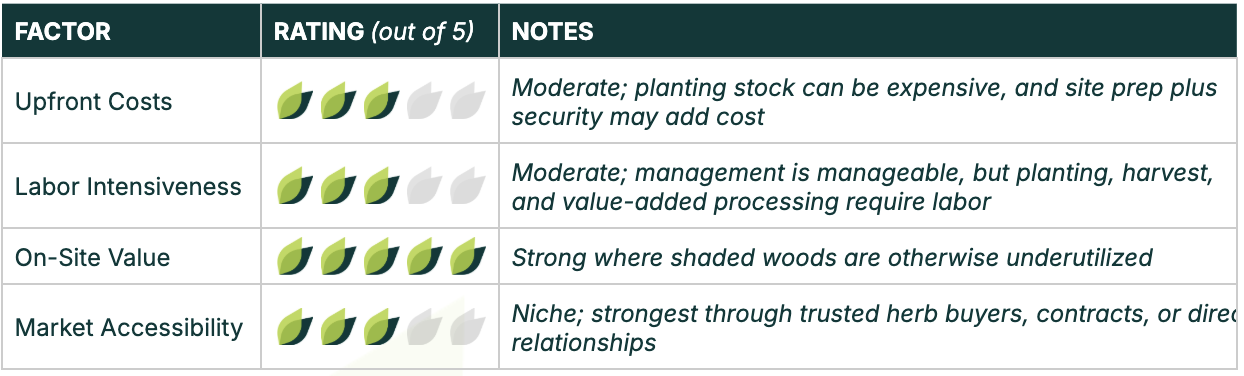
Goldenseal is worth considering if you have quality hardwood understory and patience for a slow-return crop, but the combination of long timelines, pest and theft risk, and uncertain pricing means starting small to test your site and labor capacity before committing at scale.
Silvopasture
Silvopasture combines trees with livestock grazing on the same land. Strategically placed trees provide shade and forage for animals, while the animals in turn help manage undergrowth. Well-managed silvopasture systems can reduce input costs, improve pasture quality, and open access to premium markets for grass-fed or forest-raised livestock.
Select a topic below to learn about starting and scaling a silvopasture enterprise on your land:
Economic Models
To help you make the best financial decisions for your land, we have provided select interactive Economic Models that allows you to plug in your own specific information to create a customized financial forecast.
Use the downloadable models below to ensure your enterprise is financially sustainable and the right fit for your land.
Market Directory
Navigating a new forestry enterprise naturally brings up specific questions as your project grows. To support you beyond our core curriculum, we have curated a comprehensive Resource Directory featuring trusted external guides and partner organizations. Whether you need deep-dives into enterprise budgeting, step-by-step implementation manuals, current market data, or connections to broader landowner networks, explore the links below to find the specialized knowledge and community support necessary to help your operation thrive.
| Market | Resource Type | Name | Summary |
|---|---|---|---|
| Chestnut | Budget | UMCA Chestnut Decision Support Tool | An economic decision tool for chestnuts that allows users to input information such as site preparation, spacing, layout/design, planting stock, fertilization technique, irrigation system, and management decision techniques. The tool generates economic projections such as years to break even, net present value, rate of return, and more. |
| Chestnut | Budget | Trees Forever Landowners Guide to Perennial Crop Options: Chestnuts | A decision-support worksheet with information on best practices for chestnut cultivation including site selection, cultivars, and other resources. Also includes an example enterprise budget. |
| Chestnut | Implementation | SilvoCulture's Guide to Growing Chestnuts in the Mid-Atlantic | A how-to guide and business plan for growing chestnuts, with options to grow in the context of silvopasture and alley cropping. |
| Chestnut | Implementation | SilvoCulture | Is working to establish a future cooperative for nut growers in the Mid-Atlantic region and is funding expenses such as seedlings, labor, supplies, equipment, and administrative costs to plant nut trees on farms. |
| Chestnut | Implementation | Keystone Tree Crops Cooperative | A small cooperative of nut growers, gatherers, processors, distributors, and others interested in nut production based in the Mid-Atlantic. If you currently grow, forage, or are interested in producing tree crops including chestnuts, hickory nuts, hazelnuts, and others, and live or operate in PA, NJ, MD, NY, OH, or WV, you are eligible to be a Producer Member. |
| Chestnut | Network | Northern Nut Growers Association | A growers association dedicated to researching and educating about best practices for chestnut cultivation in the Northeast. Hosts an annual conference and provides robust market and cultivation advice. |
| Chestnut | Network | New York Tree Crops Alliance Cooperative | A small cooperative whose mission is to produce high quality nuts and nut products (primarily chestnuts and hazelnuts), and to promote the cultivation and consumption of tree crops. They make their products available through retail and wholesale, domestic and international, by combining the resources of multiple growers in NYS and surrounding areas. |
| Ginseng | Budget | USDA National Agroforestry Center: Economics and Marketing of Ginseng | Information on the profitability potential of different production methods, cost and income considerations, market channels and pricing factors, and key financial and marketing insights growers should evaluate before starting ginseng production. |
| Ginseng | Implementation | Visual Site Assessment & Grading Criteria for Potential Woodland Ginseng Growing | A tool that helps prospective ginseng growers determine if their forest land is suitable for ginseng forest farming. |
| Ginseng | Implementation | The Practical Guide to Growing Ginseng | A comprehensive guide detailing ginseng preliminary considerations, botany, forest farming, pests and diseases, seed production and stratification, value-added processing, and equipment/tool suppliers. |
| Shiitake | Budget | University of Kentucky College of Agriculture: Kentucky Shiitake Production Workbook | An enterprise budget for a 500-log shiitake operation with information on best production practices. |
| Shiitake | Budget | Cornell Small Farms: Economic Report for Log-Grown Shiitake Mushrooms (2019) | A detailed report covering costs, yields, and market potential of outdoor log-cultivated shiitake production. |
| Shiitake | Budget | Cornell Small Farms Program: Specialty Mushrooms: Outdoor Production | An online resource with cultivation methods for growing specialty mushrooms on logs, stumps, woodchips, and beds outdoors. |
| Shiitake | Budget | Cornell Small Farms Program: Buying and Selling Logs for Mushroom Production | An online resource with information on sourcing, handling, and pricing bolts for mushroom production. |
| Shiitake | Budget | Cornell Small Farms Program: Shiitake Mushrooms Turning a Profit for Forest Farmers in the Northeast | A detailed resource providing profit breakdown and market channels for New England shiitake growers. |
| Shiitake | Implementation | Cornell Small Farms Program: Forcing Bolts | An online resource detailing specific steps in the process of forcing bolts and initiating fruiting. |
| Shiitake | Implementation | Cornell University: Best Management Practices for Log-Based Shiitake Cultivation in the Northeastern U.S. | A comprehensive guide on log-grown shiitake production, harvest, preservation, marketing, and more. |
| Shiitake | Implementation | Penn State: Cultivation of Shiitake on Natural and Synthetic Logs | An overview of traditional and modern shiitake mushroom production methods on both natural hardwood logs and synthetic substrates. |
| Shiitake | Training | The Forest Farmacy In-Person Classes | A farm offering in-person mushroom growing classes and trainings for a small fee. |
| Shiitake | Market | Cornell Small Farms Program: Marketing Forest-Grown Shiitake | An online resource with advice for marketing forest-grown shiitake in New York. |
| Shiitake | Market | Cornell Small Farms Program: Harvest to Market Guide | A detailed resource covering shiitake enterprise cash flow, budgeting, and record keeping. |
| Shiitake | Network | Cornell Small Farms Program's Temperate Forest Mushroom Growers Network | A subgroup of the Cornell Small Farms Program that seeks to elevate and support mushroom growers in the Northeast. Activities include providing forest stewards with resources, trainings, and technical assistance. |
| Forest Farming | Budget | Non-timber Forest Product Calculator (NTFP) | A Microsoft Excel tool for estimating the potential income from harvesting and selling nontimber forest products from a forest farming system. Users input variables (site size, yield, market price, cost) to model revenue from NTFPs under different scenarios. Provides a general scoping estimate rather than a precise budget. NTFPs include pussy willow, dogwood, pawpaw, elderberry, hybrid hazelnut, and persimmon. Relevant for the Midwest and East Coast. |
| Forest Farming | Budget | USDA NAC Forest Farming Calculator | An Excel decision-making tool to evaluate the economic potential of growing certain forest-ground understory crops including goldenseal, black cohosh, bloodroot, blue cohosh, false unicorn, and ginseng. It estimates the prices per pound of dried roots that would need to be harvested to break even based on enterprise budgets. Information on yield, planting costs, labor hours, inputs, and more is frontloaded for ease. |
| Forest Farming | Budget | Forest Farming Budget Enterprise Scenario 2: Large Scale Production | A hypothetical forest farming enterprise scenario showing an enterprise budget reflective of a diversified operation cultivating several species, marketing alternative products (leaf, planting stock, etc.), and utilizing more value-added and direct marketing approaches. |
| Forest Farming | Budget | Forest Farming Budget Enterprise Scenario 1: Small Scale Production | A hypothetical forest farming enterprise scenario showing an enterprise budget reflective of a traditional, low-diversity business growing one or two species while primarily using wholesale marketing. |
| Forest Farming | Implementation | Cornell Crop Matrix Tool: How, When and Why of Forest Farming | 27 species profiles for crops suitable for forest farming in New York state, with information on height, cultivation, field preparation and planting, field spacing and planting depth, harvest, propagation method, pruning, retail source, watering guidelines, pests and pathogens, wildlife issues, soil preferences, growth rate, longevity, and more. |
| Forest Farming | Implementation | University of Missouri Center for Agroforestry: Chapter 7: Forest Farming | A chapter on forest farming detailing benefits, challenges, types of NTFPs, types of forest farming systems, design considerations, and forest farming methods. |
| Forest Farming | Implementation | The Forest Farmers Handbook: A Beginners Guide to Growing and Marketing At-Risk Forest Herbs | The second edition of a collaboratively written guide from Rural Action, United Plant Savers, and Appalachian Sustainable Development. Includes a comprehensive introduction to forest farming and how to produce medicinal woodland herbs for market, with detailed guides for American ginseng, ramps, goldenseal, black cohosh, bloodroot, and Solomon's seal. |
| Forest Farming | Training | Cornell University's Master Forest Owner (MFO) Program | A ~7-week volunteer program through Cornell Cooperative Extension to assist private woodland owners across New York State with advice, site visits, and guidance on forest stewardship. Connects landowners with a Master Forest Owner who serves as a peer advisor ("forest owners helping forest owners") backed by Cornell's training and natural resource experts. After certification, MFOs conduct free site visits to landowners' forest properties, offering stewardship suggestions, educational support, and resource referrals. |
| Forest Farming | Market | The Farmers Market Federation of New York | |
| Forest Farming | Network | The Appalachian Forest Farmer Coalition (AFFC) | A network of forest farmers, forestland owners, universities, and governmental and non-governmental organizations with a shared goal of improving agroforestry production opportunities and farming capabilities among forest farmers. Aims to increase awareness of forest-grown medicinal and edible plants and products through education and relationship building, and to support conservation through stewardship of native plant populations. |
| Agroforestry | Training | Propagate Agroforestry Fast Track Training | A live, instructor-led online course (with recordings) designed to help farmers, land managers, and aspiring agroforestry practitioners build a practical plan for integrating trees into their farms. Focuses on design, species selection, layout, economic planning, and funding strategies. Key components: tree species and matching species to farm goals, landscape layout, economics, budgeting, funding, and capital sources. |
| Agroforestry | Implementation | Dartmouth's Northeast Agroforestry Transition Hub | A peer-learning network where cohorts of farmers participate in a series of in-person workshops, site visits, and online design and monitoring exercises to create agroforestry plans that support climate resilience. |
| Agroforestry | Implementation | Propagate's Overyield Tool | A software and decision-support farm planning tool that helps landowners, farmers, and consultants plan and evaluate agroforestry transitions by combining geospatial design, economic modeling, crop suitability data, and collaboration tools. Includes geospatial design and mapping, climate and soil layers, crop suitability maps, 25+ crops for economic modeling, 30-year cash flow forecasts, and carbon sequestration projections. |
| Agroforestry | Implementation | USDA PLANTS Database | A national online plant reference and taxonomy database providing species names, distribution maps, images, and plant trait summaries. Supports conservation, restoration, landscaping, and agroforestry by letting users query native vs. introduced status, county/state occurrences, wetland status, and species profiles. Includes the ability to look up species by scientific or common name and retrieve distribution maps, legal status, conservation status, morphology, habitat, growth habit, and more. |
| Agroforestry | Implementation | University of Missouri Center for Agroforestry Handbook for Agroforestry Planning & Design | Offers agroforestry principles, design strategies, planning steps, and management guidelines to help practitioners integrate agroforestry practices into a farming system. Discusses landscape design, functional zones, farm goals, market opportunities, and tailoring design to site conditions. Includes worksheets, planning prompts, and checklists. |
| Agroforestry | Network | Agroforestry Regional Knowledge Exchange Network (ARKx) | A peer-to-peer learning network where land managers, farmers, technical service providers, agricultural educators, business owners, non-governmental organizations, and universities can generate and share knowledge with one another to help promote agroforestry throughout the United States. |
| General | Budget | Ag Risk + Farm Management Library Enterprise Budgets Database | A database of thousands of different example enterprise budgets for dozens of commodity crops and production types across all states. |
| General | Implementation | New York Flora Association: New York Flora Atlas | An online plant database showing distribution, habitat, and specimen records for native New York plants like American ginseng, with maps and botanical details to help identify and learn about species in your area. |
| General | Implementation | Canopy Compass | A crop suitability decision-support tool to help match perennial crops to appropriate locations on a farm, given soil, topography, climate, land cover, crop history, and environmental concerns. Features tools for farm mapping and land use and cover trend analysis. |
| General | Implementation | AgroClimate Chill Hours Calculator | A decision-making tool that predicts chill hour accumulation (cold hours required by fruit trees to break dormancy) for locations in Florida and Georgia. Users select a chill model and time period, and the tool outputs interactive county-scale maps with historical and projected chill hours and comparison graphs (historic average, last season, ENSO phases). |
| General | Training | Climate Adaptation and Mitigation Fellows Program | A learning and training program for farmers, extension educators, agriculture consultants, and other agricultural advisors who are interested in planning for climate change adaptation and mitigation on farms. |
| General | Market | NY Farmers Market: Find a Farmers' Market | |
| General | Market | The Farmers Market Federation of New York: Vendor Resources & FAQ | |
| General | Market | NYS Department of Agriculture and Markets: Food Business Licensing Guidelines | |
| General | Market | NYS Department of Agriculture and Markets: Food Safety Regulations | |
| General | Market | NYS Department of Agriculture and Markets: Farmers Market Resources | |
| General | Network | Northeast Forest Farmers Coalition | A partnership of individuals, farms, universities, nonprofits, businesses, and other organizations with the shared goal of growing forest farming opportunities and education within the Northeast region. Aims to catalyze a grassroots forest farming industry grounded in promoting economic resiliency within local communities and the health of forest ecosystems. |
| General | Network | Northern Nut Growers Association | A growers association dedicated to researching and educating about best practices for nut cultivation in the Northeast. Hosts an annual conference and provides robust market and cultivation advice. |
| General | Network | NYS Grown & Certified Distributors, Producers and Retailers | |
| Black Walnut | Budget | Black Walnut Economic Model for Nut Production | An economic decision tool for black walnut production that allows users to input information such as site preparation, spacing, layout/design, planting stock, fertilization technique, irrigation system, and management decision techniques. The tool generates economic projections such as years to break even, net present value, rate of return, and more. |
| Black Walnut | Implementation | Growing Black Walnut for Nut Production: Bearing Years Management (Mizzou AF1023) | University of Missouri guide to managing mature black walnut nut orchards through the bearing years. |
| Black Walnut | Implementation | Black Walnut Plantation Management (Purdue Extension) | Purdue Extension guide on black walnut plantation establishment, thinning, pruning, and timber management. |
| Black Walnut | Implementation | Black Walnut Grower Infosheet (Savanna Institute) | Savanna Institute key crop info sheet on black walnut covering production basics, site requirements, establishment, management, yields, and markets for agroforestry systems. |
| Black Walnut | Implementation | Managing Black Walnut Forests (UMN Extension) | University of Minnesota guide on managing black walnut in mixed and pure stands for timber and nut production. |
| Black Walnut | Implementation | Growing Black Walnut for Nut Production: Orchard Establishment and Early Management | University of Missouri guide to establishing black walnut nut orchards covering site selection, planting, and early management. |
| Specialty Timber | Budget | Fruit and Nut Compass: Perennial Farm Planning Workbench | A farm business planning tool to help both new and experienced producers project the financial costs and returns from a perennial crop enterprise. Available as a free, downloadable Excel file. Enables examination of complete costs and expected returns of up to 12 crops simultaneously as part of an integrated farm plan over a 15-year period. Designed as an "open workbench" — the user enters their own assumptions about crops, yields, costs, and selling prices. |
| Sheep Fiber | Network | dìèdìè | dìẹ̀dìẹ̀ is a community-scale, cooperative textile farm and micro mill based on collectively-owned BIPoC land in the Central Piedmont region of North Carolina. They provide quality raw and processed plant-based fiber and dye materials to their bioregion and beyond, offering a local option for wholesale natural materials. |
| Sheep Fiber | Funder | The Fibers Fund | A catalytic fund to support small U.S. natural fiber and textile producers and processors, with a specific focus on environmental equity. Provides flexible financing to help fiber sector businesses access capital when needed, promote climate-beneficial agricultural practices rooted in cultural traditions, and expand access to equitable financial tools. |
| Goldenseal | Implementation | Growing and Marketing Ginseng, Goldenseal and other Woodland Medicinals, 2nd Edition | Written by professor and extension specialist Jeanine Davis at NC State and ginseng expert W. Scott Persons, this book provides in-depth information about the cultivation of woodland botanicals including ginseng, goldenseal, black cohosh, bloodroot, false unicorn, mayapple, ramps, and galax. |
| Goldenseal | Implementation | Agroforestry Note 16: Forest Production of Goldenseal | An Agroforestry Note providing an overview of the forest production of goldenseal, including uses, site selection and preparation, management considerations, propagation by seed, and marketing and economics. |
| Silvopasture | Budget | Silvopasture Tree Planting Planner Enterprise Budget | A planning and cost-estimation Excel spreadsheet where users input variables like land area, tree spacing, row layout, and material/labor costs to calculate total tree counts and overall expenses for planting in a silvopasture setting. Helps graziers and land managers model tree planting layouts and associated costs based on spacing, site dimensions, and input cost assumptions. |
| Silvopasture | Implementation | Silvopasturing in the Northeast: An Introduction to Opportunities and Strategies for Integrating Livestock in Private Woodlands | A written publication providing an overview of silvopasturing, explaining its definition and purpose, outlining ecological and economic benefits, and describing site preparation practices such as thinning, forage establishment, and livestock management. Also covers system design considerations, tree and soil protection, long-term maintenance, and management strategies for sustainable integration of trees, forage, and livestock. |
| Silvopasture | Implementation | Evaluating the Potential of a Site for Silvopasture Development | A site-assessment guide for silvopasture development outlining a scoring framework that evaluates soil quality, access, erosion risk, hazards, terrain and fencing feasibility, water availability, parcel size and location, alternative opportunities, and existing timber and understory vegetation. |
| Silvopasture | Implementation | A Framework for Successful Planning and Implementation of Silvopasture Projects | A planning-focused publication providing guidance and decision-making questions for developing quality silvopastures in farm woodlands, including considerations for site selection, tree thinning, forage establishment, fencing, grazing management, and long-term maintenance. |
| Silvopasture | Implementation | The Grazier's Guide to Trees | A practical guide for graziers explaining how integrating trees into pastures can address core challenges of grass farming, with step-by-step guidance on selecting appropriate species, planting and protecting trees in active grazing systems, designing effective layouts, phasing plantings, securing funding, and providing long-term tree aftercare. |
| Silvopasture | Implementation | UGA Warnell School of Forestry and Natural Resources: Number of Trees per Acre by Spacing Distance | A guide to silvopasture design with formulas and reference tables for estimating tree density for planting, forest management, and site assessment. Shows how density calculations inform decisions about timber value, competition, shade management, and silvicultural planning across different spacing arrangements. |
| Silvopasture | Implementation | Report on Pilot Tree Planting Initiative on Handsome Brook Farm Layer Hen Operations in New York | A case study on pastured poultry silvopasture in New York State, with lived experience testimonials and examples on techniques used for establishment, tree species selection, pasture selection, planning, and more. |
| Silvopasture | Training | Getting Started with Silvopasture Slide Deck Training Resource | A slide deck that can be used as the basis for future online trainings, with information on silvopasture benefits, resource concerns in New York State, species selection, management, and more. |
| Silvopasture | Network | Cornell Small Farms Program's Silvopasture Working Group | A working group run by the Cornell Small Farms Program that meets monthly to discuss silvopasture systems in New York and hear from practitioners and researchers about best practices. |
| Black Locust | Budget | Propagate: Black Locust Markets and Pricing | A deep dive on Black Locust markets, pricing, and grading. Also includes information on different varietals to create high-value timber. |
| Black Locust | Implementation | Cornell Small Farms Program: Black Locust: A Tree with Many Uses | An overview of Black Locust trees specifically in a New York context. General information about the trees' range, uses, implementation, pests, and market. |
| Black Locust | Implementation | Robinia pseudoacacia: Fire Effects Information System (FEIS) | An overview of Black Locust in the context of the Fire Effects Information System (FEIS). Covers distribution and occurrence, ecological characteristics, fire effects, and management considerations. |
| Black Locust | Implementation | Black Locust: A Multi-purpose Tree Species for Temperate Climates | An overview of Black Locust trees including research from Michigan State University on the chemistry of the wood. |
| Black Locust | Implementation | NRCS: Black Locust Plant Guide | An overview of Black Locust trees including distribution, habitat, uses, management, pests, environmental considerations, and different cultivars. |
Stakeholder Landscape
The stakeholder maps provide a consolidated resource identifying the key programs, buyers, service providers, and organizations operating in each emerging forest market. Rather than piecing together information from dozens of sources, landowners and partners can find regional information in one place.