
Agroforestry
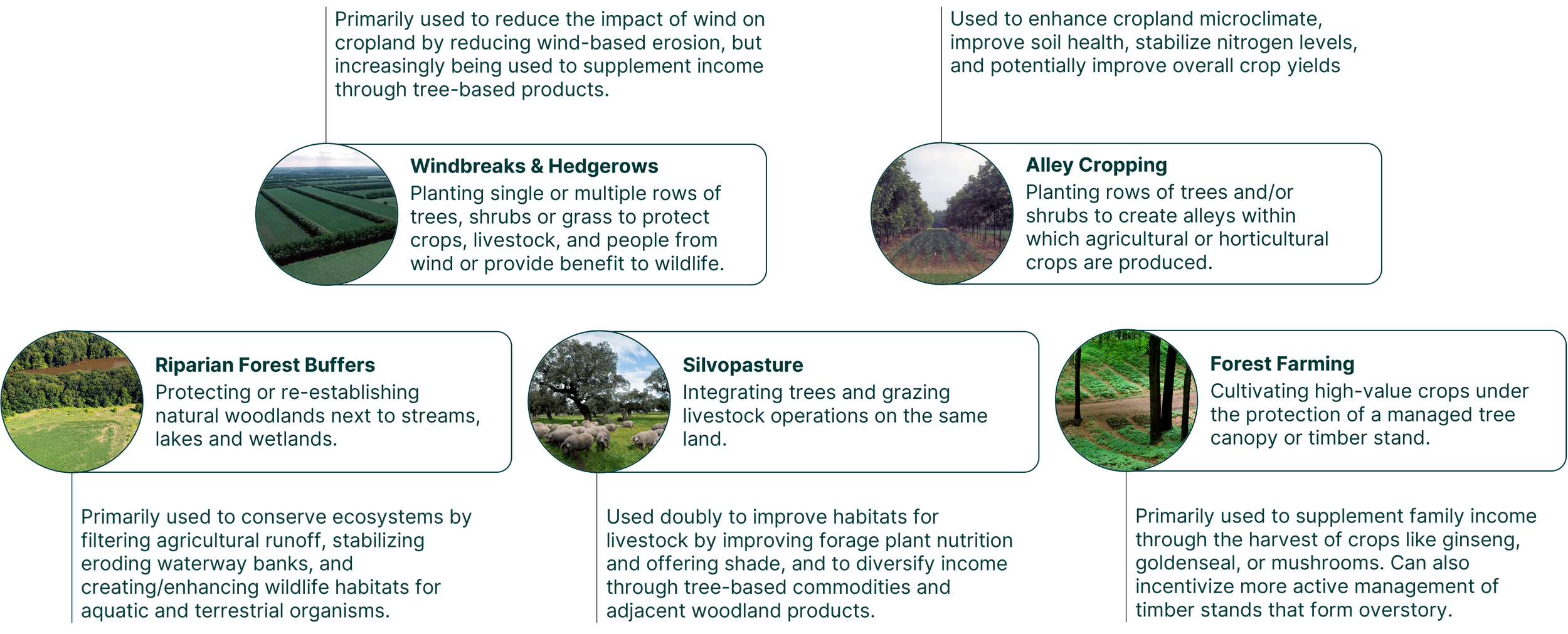
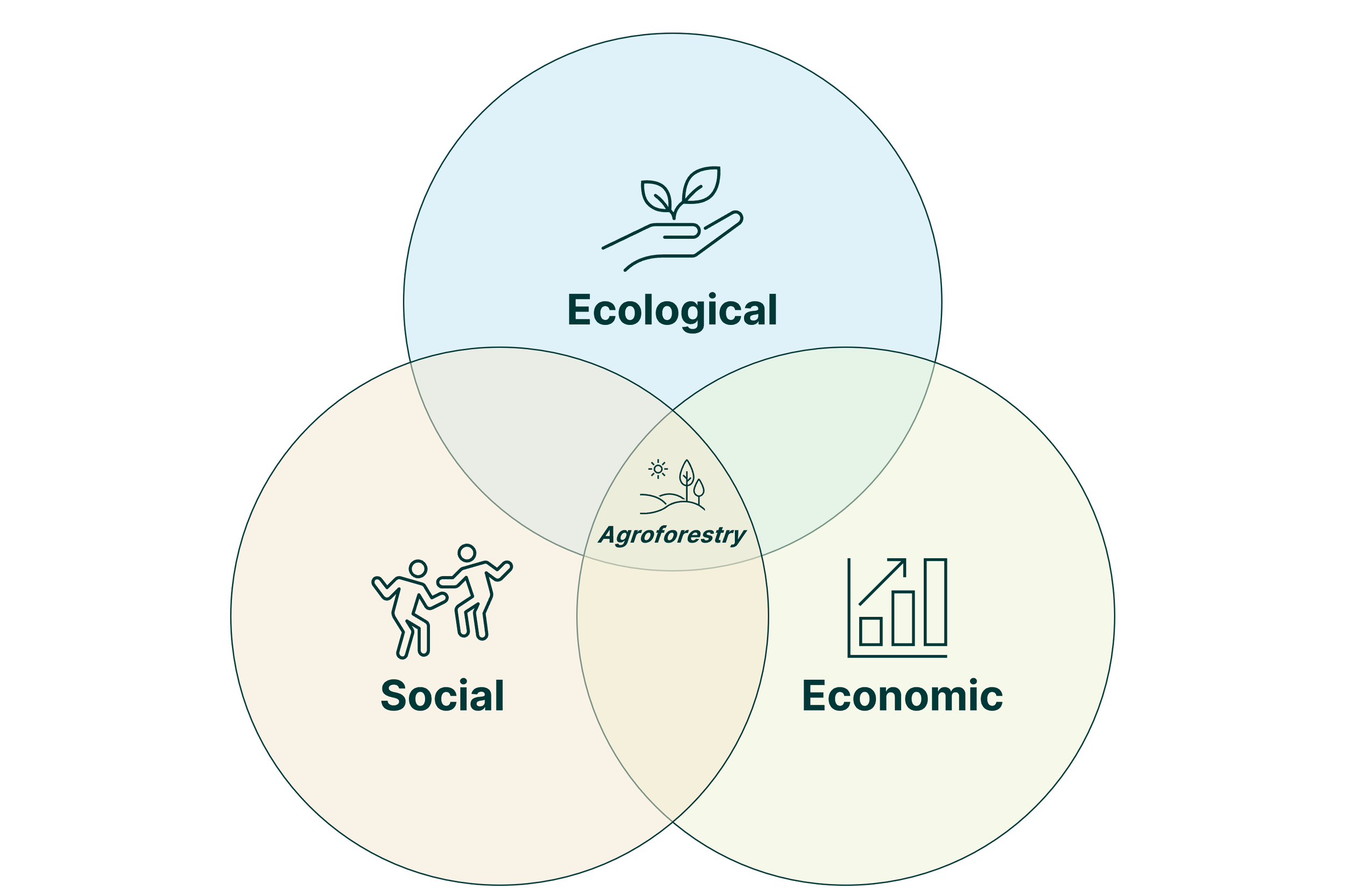
Agroforestry is the intentional integration of trees and shrubs with crops, livestock, or both. Rather than treating forestland and farmland as separate, agroforestry systems are designed so that each element supports the others — improving soil health, diversifying income, and making the land more resilient over time. For landowners across the Southeast, it represents one of the more flexible categories of emerging markets, with practices that can scale from a few acres to a full operation.
Silvopasture
Silvopasture combines trees with livestock grazing on the same land. Strategically placed trees provide shade and forage for animals, while the animals in turn help manage undergrowth. Well-managed silvopasture systems can reduce input costs, improve pasture quality, and open access to premium markets for grass-fed or forest-raised livestock.
Select a topic below to learn about starting and scaling a silvopasture enterprise on your land:
Silvopasture Species Selection:
Forest Farming
Forest farming involves cultivating high-value crops beneath an existing forest canopy, working with the shade and ecosystem conditions the forest already provides. It's a low-disturbance practice that can generate meaningful income without clearing or significantly altering your land. Ginseng, shiitake mushrooms, and elderberry are among the most established forest farming opportunities in the Southeast — and each is explored in more detail in the sections below.
Select a topic below to learn about starting and scaling a forest farming enterprise on your land:
Forest Farming Crops Regional Breakdown
Click a crop to see where it grows across the region.
Forest Farming Understory Crops:
Ginseng
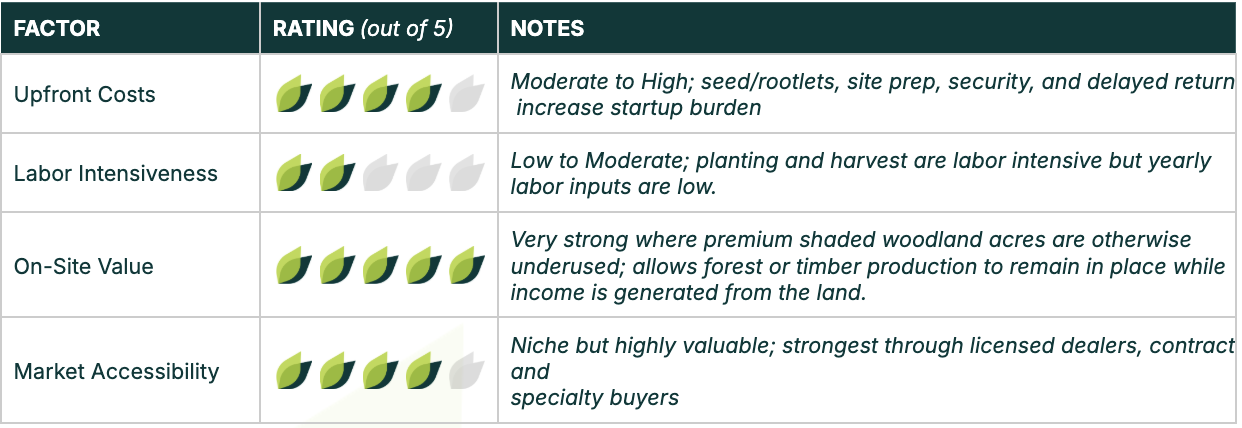
American ginseng is one of the highest-value forest crops available to Southeastern landowners, with strong and longstanding demand in both domestic and international markets. It grows well in the shaded hardwood forests common across the region and can be harvested and sold as roots, seed, or rootlets. Ginseng requires patience — roots typically take 5–10 years to mature — but the returns can be substantial for landowners willing to play the long game.
Select a topic below to learn about starting and scaling a shiitake enterprise on your land:

At a glance
American ginseng (Panax quinquefolius) is native to the U.S. and can work well in select Southeast forest farming systems where cool mesic hardwood forests, rich soils, and deep shade are available.
Ginseng is commonly harvested in its wild state, or cultivated in forest farming systems at various levels of intensity to simulate wild conditions.
Ginseng forest farming designs and management strategies exist along a gradient of intensity and include wild/wild-harvested, wild-simulated, and woods-grown systems.
Ginseng harvest cycles are typically between 6-12+ years, depending on the site and production method chosen.
Because of its high value and slow growth, wild ginseng populations have been threatened by overharvesting. It is now regulated under the Convention on International Trade in Endangered Species (CITES), with numerous regulations.
Decision Factors
Ginseng grows well in very specific environments. To determine if a site is suitable for planting, testing on a small plot is encouraged. For Southeast landowners with secure, high-quality woods with the right microclimate, ginseng can be a very valuable forest farming crop that can help preserve the forest overstory while generating income.
Shiitake
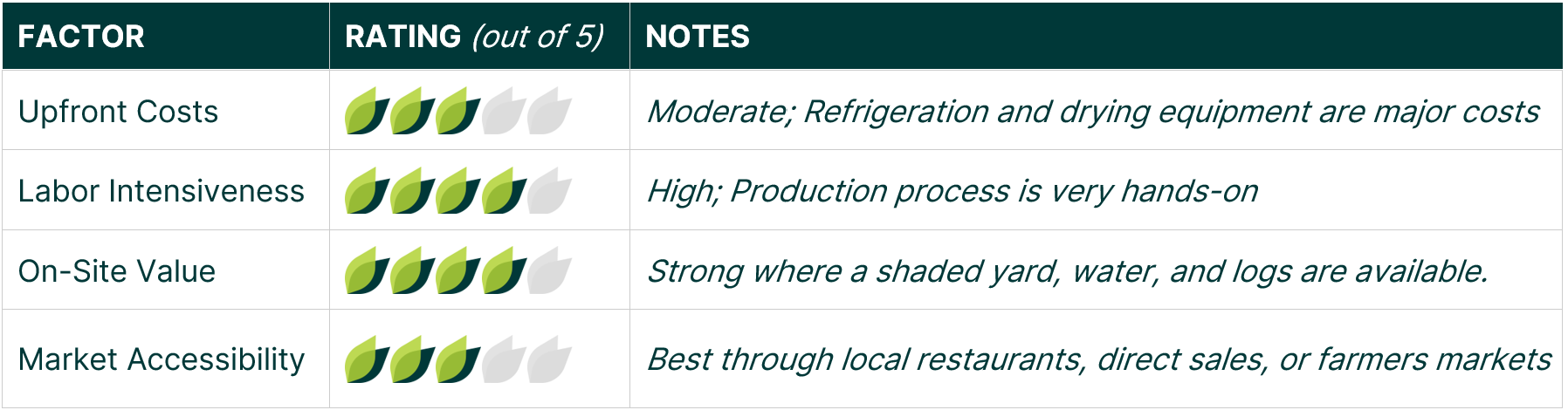
Shiitake mushrooms are well-suited to small-scale forest farming and can generate income relatively quickly compared to other forest crops. They are typically grown on cut hardwood logs — oak being the most common — inoculated with mushroom spawn and stacked in shaded, humid areas of the forest. Local farmers markets, restaurants, and food co-ops are common outlets, making shiitake a good fit for landowners interested in direct or regional sales.
Select a topic below to learn about starting and scaling a shiitake enterprise on your land:
At a glance
Shiitake can work well on properties with shaded hardwoods, dependable moisture, and a landowner willing to manage logs by hand.
Log-grown shiitake are slower than annual crops. Expect about 8-18 months from inoculation to first fruiting, but productive logs can keep fruiting for 3-6 years.
Best fit is as a diversified side enterprise with direct or local sales. Fresh mushrooms usually drive revenue; dried mushrooms, bolts, and spent logs can add value.
Decision Factors
Growing shiitake creates the most value when integrated with existing woodland management, utilizing culled hardwoods from routine thinning or firewood cutting. Start small to test your microclimate and labor capacity before scaling up.
Elderberry
Elderberry is a native shrub that grows naturally across much of the Southeast and has seen rapidly growing demand in the herbal, wellness, and food and beverage markets. It tolerates a range of light conditions, making it adaptable to forest edges and partially shaded sites. Elderberry can be harvested for berries, flowers, and cuttings, and offers landowners multiple revenue streams from a single planting.
Select a topic below to learn about starting and scaling a elderberry enterprise on your land:
At a glance
American Elderberry (Sambucus canadensis) is commonly used in hedgerows, and can also be the tree component in alley cropping systems when paired with the right alley crop.
Elderberry thrives in the Southeast in full-sun or partial shade, where moisture is reliable, and where growers have access to value-added processing ability or direct-market outlets.
Expect light harvests in about 2 years after planting, with stronger production often beginning in years 3-4 as plants mature.
Best fit is as a diversified enterprise paired with annual/understory crops, or used in hedgerows or riparian forest buffers to add value.
Decision Factors
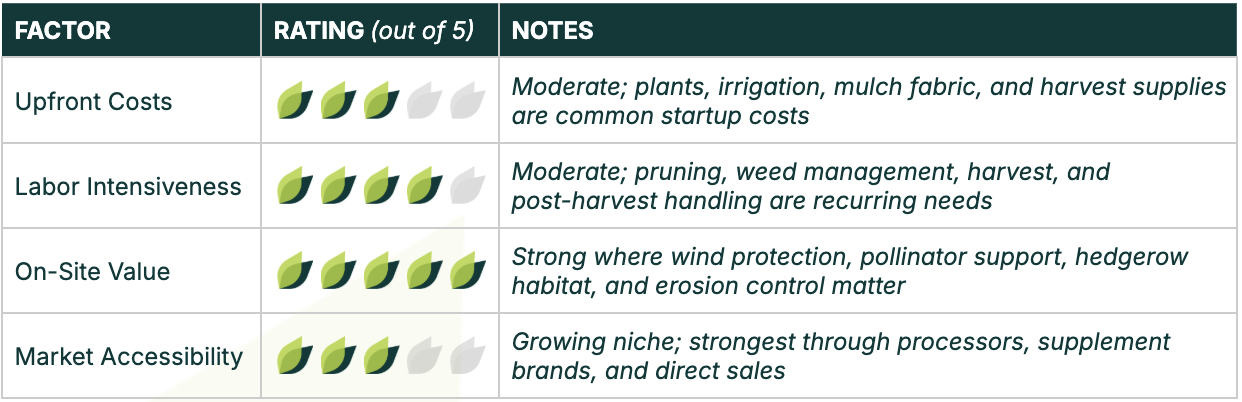
Elderberry fits well when you have field edges, paddock borders, or row crop alleys to spare, as both hedgerow and alley cropping systems let you layer perennial fruit production onto land you are already managing without displacing your primary operation.
Goldenseal
Goldenseal (Hydrastis canadensis) is a native woodland herbaceous perennial valued for the medicinal properties found in its roots and leaves. In a forest farming system, growers cultivate goldenseal beneath a managed tree canopy, often in a deciduous forest setting. Plants are established under shade using rootlets, rhizomes, or transplants, then managed over multiple years before harvest. Because the crop is slow-growing and valuable, goldenseal is often treated as a long-term specialty enterprise rather than an annual income source.
Select a topic below to learn about starting and scaling a goldenseal enterprise on your land:
At a glance
Goldenseal (Hydrastis canadensis) can work well in Southeast forest farming systems where rich woodland soils, consistent moisture, and deep shade are available.
Expect a long timeline. Harvestable roots commonly take 4-6+ years to mature after planting, depending on stock type and management.
Best fit is as a diversified side enterprise paired with existing woodlands and access to reputable medicinal herb markets.
Decision Factors
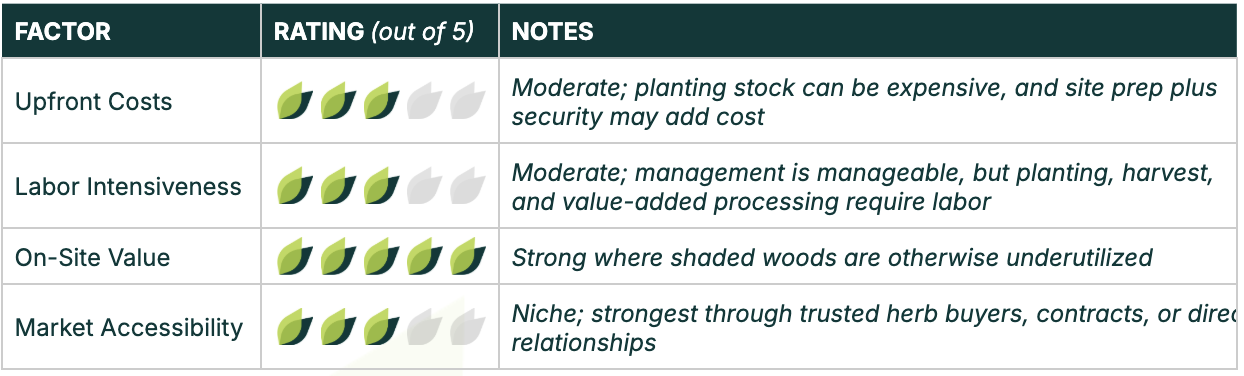
Goldenseal is worth considering if you have quality hardwood understory and patience for a slow-return crop, but the combination of long timelines, pest and theft risk, and uncertain pricing means starting small to test your site and labor capacity before committing at scale.
Persimmon
American persimmon (Diospyros virginiana) is a fruit tree native to the Southeast. Persimmons can perform well in Southeast alley cropping systems where growers are willing to integrate multiple production systems into one. It is is best viewed as a moderate-term, low-input perennial crop with niche market potential. While not typically a high-volume commodity, it can generate meaningful returns through value-added products and direct marketing.
Select a topic below to learn about starting and scaling a goldenseal enterprise on your land:
At a glance
Persimmons can perform well in Southeast alley cropping systems where growers are willing to integrate multiple production systems into one.
Agroforestry opportunity: An American persimmon enterprise can be diversified by integrating annual crops, pasture, or other crops in between rows to create a dual-income alley cropping system.
Expect a moderate timeline. Grafted trees may begin producing in about 3–5 years, with stronger yields in years 6–10. Alley crops between tree rows can produce income while trees are maturing.
Decision Factors
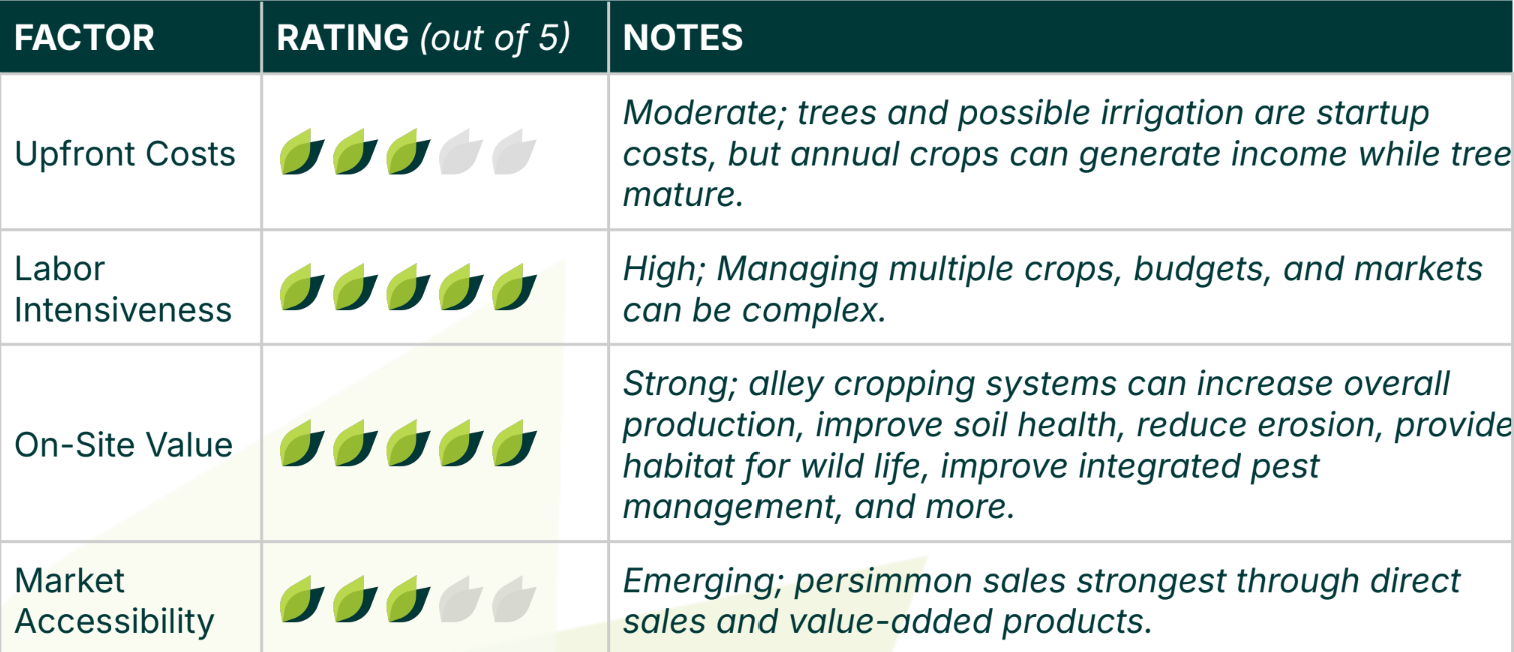
In Southeast alley cropping systems, persimmon can diversify income, increase resilience, and add ecological value without displacing annual production.
Economic Models
To help you make the best financial decisions for your land, we have provided select interactive Economic Models that allows you to plug in your own specific information to create a customized financial forecast.
Use the downloadable models below to ensure your enterprise is financially sustainable and the right fit for your land.
Market Directory
Navigating a new forestry enterprise naturally brings up specific questions as your project grows. To support you beyond our core curriculum, we have curated a comprehensive Resource Directory featuring trusted external guides and partner organizations. Whether you need deep-dives into enterprise budgeting, step-by-step implementation manuals, current market data, or connections to broader landowner networks, explore the links below to find the specialized knowledge and community support necessary to help your operation thrive.
| Market | Resource Type | Name | Summary |
|---|---|---|---|
| Black Cohosh | Implementation | Medicinal Plant Fact Sheet: Cimicifuga racemosa / Black Cohosh | A botanical, medicinal, and conservation-focused overview of black cohosh, highlighting that it is an at-risk species harvested almost entirely from the wild with a booming market but urgent need for cultivation and sustainable harvesting practices. |
| Black Cohosh | Implementation | NC State Extension Horticulture Information Leaflets: Black Cohosh (Actaea racemosa L.) | A horticultural leaflet from NC State Extension summarizing botanical information, cultivation practices, marketing, and economics of cultivating and harvesting black cohosh. |
| Black Cohosh | Implementation | Seed to Medicine Chest 2020: Propagation Techniques — Black Cohosh and Passionflower | A webinar detailing the general growing conditions for both black cohosh and passionflower, techniques for identification and how to discern from lookalikes, collection considerations for wild populations, and how to successfully vegetatively propagate the roots. |
| Black Cohosh | Implementation | United Plant Savers: Black Cohosh Cultivation & Growing Guide | A cultivation and growing guide from United Plant Savers detailing the entire lifecycle of growing black cohosh: site selection, preparation, propagation from seed and rhizome, planting, maintenance, harvest, washing, and drying. |
| Elderberry | Budget | Commercial Production of Elderberry (UT Extension) | This factsheet provides an overview of production-related considerations, including cultivar selection, pest management strategies, and estimations of elderberry establishment cash flow timelines. Especially helpful for addressing questions about the economic returns and timeline of elderberry establishment. |
| Elderberry | Implementation | Elderberry and Elderflower (Sambucus spp.): A Cultivation Guide for Florida | Florida-specific cultivation guide for American elderberry covering propagation, soil/irrigation management, planting, pruning, pest/disease control, harvest timing, postharvest handling, toxicity concerns, and differences between cultivars and native Florida phenotypes. |
| Elderberry | Implementation | Growing Elderberries: A Production Manual and Enterprise Viability Guide for Vermont and the Northeast | A comprehensive guide developed with Northeast producers in mind but applicable to wider regions. Includes basic information about cultivation, maintenance, and harvest, plus enterprise viability scenarios and information on cooperative models for sharing resources and aggregating product. |
| Elderberry | Implementation | Growing and Marketing Elderberries in Missouri | University of Missouri extension guide covering orchard establishment, cultivar selection, pest/weed/fertilization management, harvest, postharvest handling, processing, storage, market analysis, and economics for commercial American elderberry production. |
| Elderberry | Implementation | River Hills Harvest Grower Resources and Online Courses | Online classes and detailed guides from a Missouri-based commercial elderberry grower covering cultivar selection, dormant cutting propagation and planting timelines, soil/site requirements, pest management, and harvesting/processing instructions. |
| Elderberry | Network | Midwest Elderberry Cooperative | Practical resource directory for elderberry growers including plant suppliers, soil health vendors, harvesting/processing equipment, post-harvest procedures, and farm design consultants. |
| Forest Farming | Budget | Non-timber Forest Product Calculator (NTFP) | A Microsoft Excel tool for estimating the potential income from harvesting and selling nontimber forest products from a forest farming system. Users input variables (site size, yield, market price, cost) to model revenue from NTFPs under different scenarios. Provides a general scoping estimate rather than a precise budget. NTFPs include pussy willow, dogwood, pawpaw, elderberry, hybrid hazelnut, and persimmon. Relevant for the Midwest and East Coast. |
| Forest Farming | Implementation | Agroforestry Note 16: Forest Production of Goldenseal | An Agroforestry Note providing an overview of the forest production of goldenseal, including uses, site selection and preparation, management considerations, propagation by seed, and marketing and economics. |
| Forest Farming | Implementation | Alabama Cooperative Extension System | A communication channel where Alabama Extension shares news, best practices, educational resources, and stories relating to forestry, wildlife, invasive species, and natural resources management. Informs landowners, citizens, and natural resource professionals about sustainable practices, emerging challenges, and extension services in forestry and wildlife. |
| Forest Farming | Implementation | Appalachian Forest Farmers Coalition YouTube Channel | A wide variety of high-quality, informational webinars about how to plant, manage, harvest, and collect a wide variety of forest farming species. Also includes an archive of conference presentations from the forest-farming centric Gather to Grow Conference. Species of note include ginseng, goldenseal, black cohosh, bloodroot, loblolly pine, shiitake, longleaf pine, ramps, and more. |
| Forest Farming | Implementation | Ask An Agroforester Fall '25: Rethinking Herbs for Farm and Forest — Robin Suggs of ASD | A webinar describing general considerations for growing medicinal plants in a variety of agroforestry systems, highlighting ginseng, goldenseal, and black cohosh and related considerations for growing, processing, and connecting with markets. |
| Forest Farming | Implementation | Growing and Marketing Ginseng, Goldenseal and Other Woodland Medicinals, 2nd Edition | A book by professor and extension specialist Jeanine Davis at NC State and ginseng expert W. Scott Persons, providing in-depth information about the cultivation of woodland botanicals. Includes information about a variety of medicinals, including ginseng, goldenseal, black cohosh, bloodroot, false unicorn, mayapple, ramps, and galax. |
| Forest Farming | Implementation | Lincoln University Cooperative Research: Non-Timber Forest Product (NTFP) Black Cohosh | A factsheet providing basic information about propagation, pests, and harvesting of black cohosh. |
| Forest Farming | Implementation | NC State Extension Horticultural Leaflets: Commercial Goldenseal Production (Hydrastis canadensis L.) | A horticultural leaflet from NC State Extension summarizing botanical information, regulations, uses, cultivation, propagation (vegetative and seed), and harvesting of goldenseal. |
| Forest Farming | Implementation | Propagate Agroforestry Fast Track Training | A live, instructor-led online course (with recordings) designed to help farmers, land managers, and aspiring agroforestry practitioners build a practical plan for integrating trees into their farms. The course focuses on design, species selection, layout, economic planning, and funding strategies. |
| Forest Farming | Implementation | The Forest Farmer's Handbook: A Beginner's Guide to Growing and Marketing At-Risk Forest Herbs | The second edition of a collaboratively written guide from Rural Action, United Plant Savers, and Appalachian Sustainable Development. Includes a comprehensive introduction to forest farming and how to produce medicinal woodland herbs for market. Includes detailed guides for American ginseng, ramps, goldenseal, black cohosh, bloodroot, and Solomon's seal. |
| Forest Farming | Implementation | USDA NRCS PLANTS Database — Ilex vomitoria | USDA NRCS Plant Guide for Yaupon (Ilex vomitoria) — comprehensive reference covering botanical description, native distribution, habitat requirements, hardiness, wildlife and ethnobotanical uses including historic black drink preparation, propagation methods, commercial cultivars, planting guidelines, and management including prescribed fire and sucker control. |
| Forest Farming | Network | Agroforestry Regional Knowledge Exchange Network (ARKx) | A peer-to-peer learning network where land managers/farmers, technical service providers, agricultural educators, business owners, NGOs and universities can generate and share knowledge with one another to help promote agroforestry throughout the United States. |
| Forest Farming | Network | The Appalachian Forest Farmer Coalition (AFFC) | A network of forest farmers, forestland owners, universities, governmental and non-governmental organizations that share a common goal of improving agroforestry production opportunities and farming capabilities among forest farmers. The collective aim is to increase awareness of forest-grown medicinal, edible plants and products through education and relationship building, and support conservation efforts through stewardship of existing plant populations and forest farming of these native botanicals. |
| General | Implementation | A Loblolly Pine Management Guide: When and Where to Apply Fertilizer (USDA FS GTR-SE-316) | USDA Forest Service technical guide on fertilizer application for loblolly pine plantations. |
| General | Implementation | A Tennessee Landowner and Practitioner Guide for Shortleaf Pine Establishment (UT/SPI PB 1751) | UT Extension guide for landowners and practitioners on shortleaf pine establishment and management. |
| General | Implementation | Loblolly Pine-based Forage Production: What We're Learning in Arkansas | USDA-ARS Dale Bumpers Small Farms Research Center paper on loblolly pine-based agroforestry covering forage yield and quality responses to tree spacing, effects of shade on cool and warm-season grasses, forage species persistence, nitrogen fertilizer recovery, and management recommendations for livestock grazing in pine alleys. |
| General | Implementation | Managing Fusiform Rust on Loblolly and Slash Pine (Alabama Extension) | Alabama Extension guide on identifying and managing fusiform rust disease in loblolly and slash pine. |
| General | Implementation | Managing Loblolly Pine Stands from A to Z (UA Extension FSA-5023) | University of Arkansas Extension guide on managing loblolly pine stands covering establishment, silvicultural practices, and harvest considerations. |
| General | Implementation | Restoration of Shortleaf Pine in the Southern US: Strategies and Tactics (USDA FS) | USDA Forest Service publication on strategies and tactics for shortleaf pine restoration in the southern US. |
| General | Implementation | Restoring Shortleaf Pine Forests (The Nature Conservancy) | Case study of shortleaf pine restoration efforts in Arkansas. |
| General | Implementation | Silvics of North America: Pinus elliottii (USDA FS) | USDA Forest Service silvics chapter on slash pine covering range, growth, regeneration, and management. |
| General | Implementation | Silvics of North America: Pinus taeda (USDA FS) | USDA Forest Service silvics chapter on loblolly pine covering range, growth, regeneration, and management. |
| General | Implementation | Technical Guidelines for East Texas Pine Establishment and Quality Assurance (TX A&M Forest Service) | Texas A&M Forest Service technical guidelines for pine establishment in East Texas. |
| General | Implementation | Thinning Southern Pines: A Key to Greater Returns (UF/IFAS FR159) | UF/IFAS publication on thinning southern pine plantations to improve growth and economic returns. |
| General | Implementation | USDA NRCS Plant Guide — Slash Pine | USDA NRCS plant guide on slash pine covering identification, ecology, uses, and establishment. |
| General | Implementation | Using Soils to Guide Fertilizer Recommendations for Southern Pines (UF/IFAS FR053) | UF/IFAS publication on using soil characteristics to guide fertilizer decisions for southern pine plantations. |
| General | Network | Shortleaf Pine Initiative | Regional initiative supporting shortleaf pine restoration with grower resources, training, and management guidance. |
| Muscadine | Implementation | 2025 Southeast Regional Muscadine Grape Integrated Management Guide (UGA AP-126-4) | Annually updated (2025) Southeast regional IPM guide with detailed fungicide/insecticide efficacy tables, spray schedules by crop stage, weed management programs with herbicide resistance guidance, and pest thresholds for commercial muscadine grape production. |
| Muscadine | Implementation | 2025 Southeast Regional Muscadine Grape Integrated Management Guide (UGA Field Report) | Annually updated (2025) UGA Extension IPM guide for Southeast muscadine grape production with fungicide/insecticide recommendations, spray schedules by crop stage, pest/disease management thresholds, weed control options, and herbicide resistance guidance. |
| Muscadine | Implementation | Establishment and Production of Muscadine Grapes (MSU P2290) | Comprehensive Mississippi State Extension guide covering muscadine vineyard establishment, site selection, trellis systems, cultivar selection with detailed characteristics table, training, pruning, fertilization, irrigation, weed control, disease identification and management, and insect pest control. |
| Muscadine | Implementation | Muscadine Grape Production Guide for the Southeast (NC State) | Comprehensive NC State Extension guide (updated Sept. 2025) covering all aspects of muscadine grape production in the Southeast. |
| Muscadine | Implementation | NC Muscadine Grape Association YouTube Channel | The NC Muscadine Grape Association YouTube channel is the official video resource for the North Carolina industry organization serving muscadine grape growers with educational content. |
| Muscadine | Implementation | University of Georgia Extension Viticulture Resources | Comprehensive UGA viticulture resource site covering muscadine and vinifera grape production with sections on cultivar selection, canopy management, vineyard nutrition, pest/disease management, weed science, economics, regional growing guides, educational videos, and blog posts on current issues. |
| Persimmon | Implementation | ATTRA / NCAT — Persimmon Production | ATTRA sustainable agriculture resource on persimmon production methods and markets. |
| Persimmon | Implementation | American Persimmon (UK Center for Crop Diversification CCD-CP-001) | University of Kentucky crop profile on American persimmon covering production, marketing, and economics. |
| Persimmon | Implementation | Common Persimmon: NTFPs from Trees — Nontimber Forest Products that Support our Society and Economy | USDA Forest Service publication discussing common persimmon as a nontimber forest product. |
| Persimmon | Implementation | Persimmon Crop Profile (AgMRC) | Agricultural Marketing Resource Center profile on persimmon production, markets, and economics. |
| Persimmon | Implementation | Persimmon Species Profile (Savanna Institute) | Species profile on American persimmon for agroforestry applications including silvopasture. |
| Persimmon | Implementation | Persimmons: Folklore, Fruit Exploring, and Genetics — with Eliza Greenman (Savanna Institute) | Savanna Institute episode with Eliza Greenman exploring American persimmon folklore, fruit characteristics, and genetic diversity. |
| Shiitake | Budget | Cornell Small Farms: Economic Report for Log-Grown Shiitake Mushrooms (2019) | A detailed report covering costs, yields, and market potential of outdoor log-cultivated shiitake production. |
| Shiitake | Budget | University of Kentucky College of Agriculture: Kentucky Shiitake Production Workbook | An enterprise budget for a 500-log shiitake operation with information on best production practices as well. |
| Shiitake | Implementation | Best Management Practices for Log-Based Shiitake Cultivation (Cornell Small Farms) | Cornell Small Farms' practical guide for log-based shiitake cultivation covers species selection, log acquisition and timing, inoculation, incubation in layering yards, forcing/shocking schedules, harvest techniques, pest management, and market strategies for commercial production. |
| Shiitake | Implementation | Field and Forest Products Mushroom Spawn | A mushroom spawn supplier and decision-making tool for deciding what strains are right for which environments. |
| Shiitake | Implementation | Kentucky Shiitake Production Workbook: Introduction — Shiitake: The Forest Mushroom | A workbook about shiitake's market interest and basic cultivation process as an option for woodland owners or growers. |
| Shiitake | Implementation | NC State Extension: Mushrooms | A database of 11 case studies on shiitake mushroom growers, with detailed information on marketing strategies. |
| Shiitake | Implementation | Organic Mushroom Farming and Mycoremediation (Tradd Cotter) | Chelsea Green Publishing book by Tradd Cotter — comprehensive guide covering organic mushroom production methods, indoor and outdoor cultivation techniques, and mycoremediation applications. |
| Shiitake | Implementation | Potential Alternative Tree Species as Substrates for Forest Farming of Log-grown Shiitake in the SE US | USDA Forest Service research on alternative hardwood species suitable as shiitake substrates in the Southeast. |
| Shiitake | Implementation | Producing Shiitake Mushrooms: A Guide for Small-Scale Outdoor Cultivation on Logs (NC State) | NC State Extension production guide for log-based shiitake cultivation covering site/log selection, inoculation, spawn run, fruiting management, environmental conditions, harvest timing, and troubleshooting for small-scale outdoor growers. |
| Shiitake | Implementation | Shiitake Mushroom Production Fact Sheet Series (Ohio State Extension) | Ohio State Extension overview of shiitake production covering six cultivation steps: spawn acquisition and storage, log selection, inoculation with hole spacing, log layering for colonization, log positioning for fruiting, and harvesting. Includes economics comparison for hobbyist vs. commercial operations and spawn supplier directory. |
| Shiitake | Implementation | The Basics of Hardwood-Log Shiitake Mushroom Production and Marketing (Virginia Cooperative Extension) | Virginia Cooperative Extension guide covering hardwood-log shiitake production methods including log selection, inoculation timing and techniques, incubation/spawn-run management, soaking for fruiting, pest and disease management, harvesting, and detailed financial analysis including break-even pricing, yield calculations, and marketing strategies for farmers markets and restaurants. |
| Shiitake | Implementation | The Forest Farmacy In-Person Classes | A farm offering in-person mushroom growing classes and trainings for a small fee. |
| Shiitake | Market | Forest Grown Verified Program | A certification program established to create a voluntary, third-party verification process for non-timber forest-grown products that are produced and harvested in a sustainable and legal manner. |
| Silvopasture | Budget | Ag Risk + Farm Management Library Enterprise Budgets Database | A database of thousands of different example enterprise budgets for dozens of commodity crops and production types across all states. |
| Silvopasture | Budget | Silvopasture Tree Planting Planner Enterprise Budget | A planning and cost-estimation Excel spreadsheet where users input variables like land area, tree spacing, row layout, and material/labor costs to calculate total tree counts and overall expenses for planting in a silvopasture setting. Helps graziers or land managers model tree planting layouts and associated costs based on spacing, site dimensions, and input cost assumptions. |
| Silvopasture | Implementation | A Framework for Successful Planning and Implementation of Silvopasture Projects | A planning-focused publication that provides guidance and decision-making questions for developing quality silvopastures in farm woodlands, including considerations for site selection, tree thinning, forage establishment, fencing, grazing management, and long-term maintenance. |
| Silvopasture | Implementation | AgroClimate Chill Hours Calculator | A decision-making tool that predicts chill hour accumulation for locations in Florida and Georgia. Users select a chill model and time period, and the tool outputs interactive county-scale maps with historical and projected chill hours. Provides graphs for comparisons (historic average, last season, ENSO phases) to help growers assess whether a site will reliably meet a crop's chilling requirements under climate variability. |
| Silvopasture | Implementation | Cal Poly's SelecTree — A Tree Selection Guide | A digital tree-selection tool, helping users pick tree species suited to their site by matching traits (soil, climate, size, tolerances, fall color, utility friendly, salt tolerance, wind resilience, deer palatable, water use rating, shade tolerance, flower color, fruit type). Offers species profiles, filtering by attributes, and grading for suitability across Californian and broader U.S. contexts. |
| Silvopasture | Implementation | Conversion of an Oak Seed Orchard to Oak Silvopasture (USDA FS) | USDA Forest Service research paper documenting the conversion of an Alabama oak seed orchard into a hardwood silvopasture system, comparing growth metrics across six oak species. |
| Silvopasture | Implementation | Evaluating the Potential of a Site for Silvopasture Development | A site-assessment guide for silvopasture development, outlining a scoring framework that evaluates factors such as soil quality, access, erosion risk, hazards, terrain and fencing feasibility, water availability, parcel size and location, alternative opportunities, and existing timber and understory vegetation. |
| Silvopasture | Implementation | From Pine Forest to a Silvopasture System (USDA NAC) | A guide for establishing silvopasture by subtraction specifically in pine forest ecosystems in the Southeast, with case studies and information on establishment, design, management, thinning, and practices for yielding high-quality timber and forage. |
| Silvopasture | Implementation | Report on Pilot Tree Planting Initiative on Handsome Brook Farm Layer Hen Operations in New York | A case study on pastured poultry silvopasture in New York State, with lived experience testimonials and examples on techniques used for establishment, tree species selection, pasture selection, planning, and more. |
| Silvopasture | Implementation | Shortleaf Pine Initiative: Silvopastural Management | Shortleaf Pine Initiative technical guide on silvopastural management covering tree spacing, forage options (cool and warm-season grasses), establishment methods, livestock management, environmental benefits, and special considerations for managing shortleaf pine in silvopasture systems. |
| Silvopasture | Implementation | Silvopasture Establishment and Management Principles for Pine Forests in the Southeastern United States | USDA National Agroforestry Center handbook covering planning, establishment, and management of pine silvopasture systems including tree, forage, and livestock components, grazing systems, fencing, and economics. |
| Silvopasture | Implementation | Silvopasture: Grazing Systems Can Add Value to Trees (MSU Extension) | Mississippi State Extension publication (P2847) on silvopasture covering tree and forage species selection, planting designs and tree spacing tables, establishment methods, livestock management, grazing strategies, water and fencing requirements, and economic returns compared to pasture-only or timber-only systems. |
| Silvopasture | Implementation | The Grazier's Guide to Trees | A practical guide for graziers that explains how integrating trees into pastures can address core challenges of grass farming, while outlining step-by-step guidance on selecting appropriate species, planting and protecting trees in active grazing systems, designing effective layouts, phasing plantings, securing funding, and providing long-term tree aftercare. |
| Silvopasture | Implementation | Tree Selection Guide for Mid-Atlantic Silvopastures | Helps Mid-Atlantic farmers select native North American trees over 25 feet tall — both deciduous and evergreen — suitable for silvopasture operations across seven states. |
| Silvopasture | Implementation | UGA Warnell School: Number of Trees per Acre by Spacing Distance | A guide to silvopasture design with formulas and reference tables that allow users to estimate tree density for planting, forest management, and site assessment. Also shows how these density calculations inform decisions about timber value, competition, shade management, and silvicultural planning across different spacing arrangements. |
| Yaupon Holly | Implementation | Yaupon Holly Culture and Pest Management for Tea Production and Ornamental Use (UF/IFAS ENY-2054) | Comprehensive University of Florida/IFAS publication covering yaupon holly cultivation, pest management, harvesting, and processing for commercial tea production. |
| Yaupon Holly | Implementation | Yaupon Holly: America's Native Tea Plant (UF/IFAS Putnam County) | UF/IFAS Extension blog post covering yaupon holly's native range, cultivation in sandy Florida soils, harvesting and processing for tea, and case study of commercial production at Eagles Nest Farm in Putnam County with nematode monitoring and organic weed management. |
| Yaupon Holly | Implementation | Yaupon Odyssey: Unearthing America's Herbal Legacy | Yaupon Wellness Company podcast episode featuring tea farmer Lou Thomann discussing yaupon's history, medicinal uses, tea brewing, skincare applications, sustainable farming practices at their research farm, and Native American heritage. |
| Yaupon Holly | Network | American Yaupon Association | Industry trade group promoting sustainable yaupon production, quality standards, and consumer education. Relaunching summer 2025. |