
Specialty Timber
Specialty timber species are native hardwoods and distinctive conifers grown for high-value, niche markets beyond commodity sawlogs and pulpwood. Where much of the Northeast woodlot is left to grow whatever comes up (e.g., low-value red maple, beech, and pulpwood), specialty timber prioritizes wood quality, unique material properties, and diverse end-uses including veneer, fine furniture, and specialty flooring. These species can also deliver value beyond timber through nut crops, sap, wildlife habitat, ecosystem services, and agroforestry integration.
Potential Benefits
Premium Markets. Specialty timber commands higher prices per board foot than the red maple, beech, and pulpwood that fill most Northeast woodlots.
Stacked income. Many of these species pay out well before and well beyond final harvest. Black walnut and Chinese chestnut produce nut crops; black locust supports silvopasture, durable fence posts, and honey.
Legacy asset with ecological co-benefits. Rotations run 60–80+ years, making these stands a generational holding rather than a short-cycle commodity. Along the way the plantings build soil (black locust fixes nitrogen), stabilize erodible ground, and provide wildlife habitat.
What to Know Going In
Rotations are long, and cash flow has gaps. Final harvest for some species can span up to 60–80 years out, with long stretches in between without major timber revenue. Mapping nut income, interim thinnings, and cost-share before you plant is what keeps the timeline workable.
Early management is non-negotiable. Weed control in years 1–5 and pruning in years 5–15 determine final log grade. Skipping early management is the most common way to undercut a stand's long-term value.
Site and species choice are unforgiving. Most of these species are picky: walnut needs deep, well-drained, frost-free sites; chestnut fails on wet or alkaline ground; and black locust carries invasive-species planting restrictions in New York, so confirm the rules before planting
Selected Specialty Species
Click a species to shade every county by how well-suited it is — paler counties are marginal, fuller color marks the strongest sites.
Black Walnut
Costs
Seedlings: $0.50–$1.50/tree (NY DEC Saratoga Tree Nursery); $2–$8/tree for improved cultivars
Establishment: $700–$1,400/ac; NRCS cost-share can offset 50–90%
Management: Weed control critical yrs 1-5; pruning critical yrs 5-15 for final log grade
Revenue
Nut crop: Grafted yr 4–7, seedlings yr 10+; in-hull buyers pay ~$0.10–$0.20/lb, but limited Northeast hulling stations
Intermediate thinning: Modest timber revenue beginning yr 15–20
Final harvest: $25,000–$60,000+/ac on high-grade veneer sites (Walnut Council)
A large, long-lived hardwood native to the Central and Eastern US, black walnut is among the most valuable timber trees in North America. It produces premium-grade lumber and veneer alongside an edible nut crop making it one of the few species that can generate meaningful income both early in rotation and at final harvest. Its native range reaches its northern edge in New York and it grows best on deep, moist, well-drained bottomland and lower-slope soils. Does well in warmer, more sheltered sites (e.g., Hudson Valley, Finger Lakes, Lake Plains, Mohawk/Champlain valleys).
Good fit if:
Deep, well-drained, fertile loam or silt loam; 3+ ft to bedrock; pH 6.5–7.2
Caution if:
Economics
Warm, sheltered sites with good cold-air drainage; benches and mid-slopes
Shallow, sandy, waterlogged, or compacted soils; hardpan or clay within 3 ft
Milder zones (USDA 5, warm 4b): Hudson Valley, Finger Lakes, Lake Plains
Cold, exposed, high-elevation sites: Adirondacks, Tug Hill, high Catskills
Companion plantings sited outside the root zone
Juglone-sensitive plants nearby: tomatoes, apples, pines, alfalfa
Frost pockets: valley bottoms and basins where cold air settles
Costs
Seedlings: $5–$15 each, grafted cultivars ~$20–$40
Establishment: ~$3,000–$8,000/ac over the first ~5 years, deer fencing included
Management: Annual mowing/weed control, pruning, and pest monitoring
Chestnut
Revenue
Nut crop: First nuts around year 5-7, significant production by years 8–10
Peak Yield: ~2k–3k lb/ac on well managed sites, generally reached by ~year 15
Sale: $2–$3/lb wholesale, $4–$7+/lb retail/direct
An orchard-style tree grown primarily for an annual edible nut crop, with rot-resistant wood as a secondary benefit. Due to historic blight, the Chestnut trees planted today are typically blight-resistant Chinese chestnut and hybrids, which do best on warm, well-drained, slightly acidic sites: Hudson Valley, Finger Lakes, and Lake Erie/Ontario belts.
Good fit if:
Caution if:
Economics
Well-drained sandy or loamy soil, slightly acidic (pH ~5.5–6.5); tolerates rockier, poorer ground than walnut
Full sun on warm, sheltered sites with good air drainage; milder zones (USDA 5–6)
Wet, heavy clay, or low spots that pool water. Phytophthora "ink" root rot kills trees on poorly drained ground
Open land or old fields you can manage orchard-style
Frost pockets or cold, exposed, high-elevation sites; late frost cuts nut set
Blight-resistant Chinese or hybrid stock from a reputable chestnut nursery
Heavy deer pressure without protection; young trees will need need fencing or tubes
Alkaline or limestone soils (pH > ~7); causes yellowing/chlorosis; common in western NY
Costs
Seedlings: $1.00–$2.00/tree; $11–$15/tree for improved cultivars (via NE plant suppliers)
Establishment: $2,500–$4,700/ac; NRCS cost-share can offset 50–90%
Management: Pruning and pest control critical annually; thinning starting in year 7
Black Locust
Revenue
Post Harvest: Modest timber revenue ~$1.00-$20.00/lft beginning yr 12–15
Sawtimber: Year 20-30 final timber harvest ~$3.50–$20.00/bft depending on varietal
Offsetting Costs: Incorporate into agroforestry systems or offset farm costs (fenceposts)
Black Locust is a fast-growing, rot-resistant, nitrogen-fixing hardwood native to the Appalachian Mountains and Ozark Plateau. It thrives in a variety of challenging soils and produces extremely durable wood suited for outdoor applications, like fence posts, but is underutilized in the U.S. due to pest and disease pressures and its invasive species designation in some regions.
Good fit if:
Caution if:
Economics
5–50 acres of well-drained soil and ample precipitation in the summer
Interest and bandwidth for long-term management
Site has poorly drained clay, permanently wet or compacted soils
Ability to integrate livestock or crops (silvopasture/alley cropping), or need to protect from soil erosion (riparian buffers)
Your state considers Black Locust an invasive species (due to it’s high growth rate and prolific spread)
USDA Climate Zones 4-8
You need immediate cashflow (before Year 7)
Lacking upfront capital or the time/bandwidth to navigate decentralized market
Christmas Trees
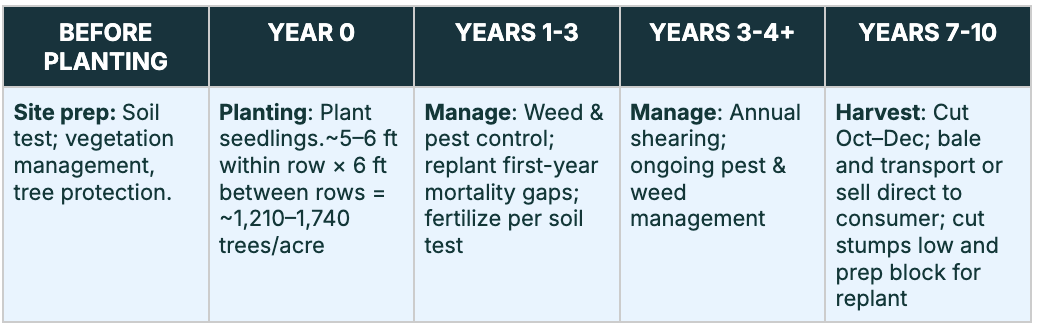
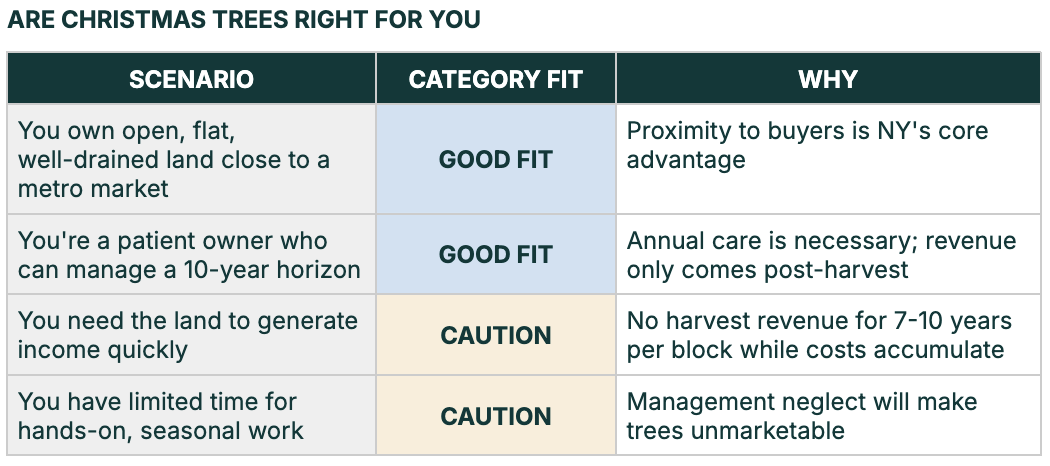
Christmas tree seedlings are transplanted in a treeless area (usually flat, accessible fields) and grown for 7–10 years into a marketable 6–7 foot tall tree. Trees are sold directly to consumers as choose-and-cut, pre-cut and sold wholesale to retail lots and distributors, or integrated into a broader agritourism experience.
Economic Models
To help you make the best financial decisions for your land, we have provided select interactive Economic Models that allows you to plug in your own specific information to create a customized financial forecast.
Use the downloadable models below to ensure your enterprise is financially sustainable and the right fit for your land.
Market Directory
Navigating a new forestry enterprise naturally brings up specific questions as your project grows. To support you beyond our core curriculum, we have curated a comprehensive Resource Directory featuring trusted external guides and partner organizations. Whether you need deep-dives into enterprise budgeting, step-by-step implementation manuals, current market data, or connections to broader landowner networks, explore the links below to find the specialized knowledge and community support necessary to help your operation thrive.
| Market | Resource Type | Name | Summary |
|---|---|---|---|
| Chestnut | Budget | UMCA Chestnut Decision Support Tool | An economic decision tool for chestnuts that allows users to input information such as site preparation, spacing, layout/design, planting stock, fertilization technique, irrigation system, and management decision techniques. The tool generates economic projections such as years to break even, net present value, rate of return, and more. |
| Chestnut | Budget | Trees Forever Landowners Guide to Perennial Crop Options: Chestnuts | A decision-support worksheet with information on best practices for chestnut cultivation including site selection, cultivars, and other resources. Also includes an example enterprise budget. |
| Chestnut | Implementation | SilvoCulture's Guide to Growing Chestnuts in the Mid-Atlantic | A how-to guide and business plan for growing chestnuts, with options to grow in the context of silvopasture and alley cropping. |
| Chestnut | Implementation | SilvoCulture | Is working to establish a future cooperative for nut growers in the Mid-Atlantic region and is funding expenses such as seedlings, labor, supplies, equipment, and administrative costs to plant nut trees on farms. |
| Chestnut | Implementation | Keystone Tree Crops Cooperative | A small cooperative of nut growers, gatherers, processors, distributors, and others interested in nut production based in the Mid-Atlantic. If you currently grow, forage, or are interested in producing tree crops including chestnuts, hickory nuts, hazelnuts, and others, and live or operate in PA, NJ, MD, NY, OH, or WV, you are eligible to be a Producer Member. |
| Chestnut | Network | Northern Nut Growers Association | A growers association dedicated to researching and educating about best practices for chestnut cultivation in the Northeast. Hosts an annual conference and provides robust market and cultivation advice. |
| Chestnut | Network | New York Tree Crops Alliance Cooperative | A small cooperative whose mission is to produce high quality nuts and nut products (primarily chestnuts and hazelnuts), and to promote the cultivation and consumption of tree crops. They make their products available through retail and wholesale, domestic and international, by combining the resources of multiple growers in NYS and surrounding areas. |
| Black Walnut | Budget | Black Walnut Economic Model for Nut Production | An economic decision tool for black walnut production that allows users to input information such as site preparation, spacing, layout/design, planting stock, fertilization technique, irrigation system, and management decision techniques. The tool generates economic projections such as years to break even, net present value, rate of return, and more. |
| Black Walnut | Implementation | Growing Black Walnut for Nut Production: Bearing Years Management (Mizzou AF1023) | University of Missouri guide to managing mature black walnut nut orchards through the bearing years. |
| Black Walnut | Implementation | Black Walnut Plantation Management (Purdue Extension) | Purdue Extension guide on black walnut plantation establishment, thinning, pruning, and timber management. |
| Black Walnut | Implementation | Black Walnut Grower Infosheet (Savanna Institute) | Savanna Institute key crop info sheet on black walnut covering production basics, site requirements, establishment, management, yields, and markets for agroforestry systems. |
| Black Walnut | Implementation | Managing Black Walnut Forests (UMN Extension) | University of Minnesota guide on managing black walnut in mixed and pure stands for timber and nut production. |
| Black Walnut | Implementation | Growing Black Walnut for Nut Production: Orchard Establishment and Early Management | University of Missouri guide to establishing black walnut nut orchards covering site selection, planting, and early management. |
| Specialty Timber | Budget | Fruit and Nut Compass: Perennial Farm Planning Workbench | A farm business planning tool to help both new and experienced producers project the financial costs and returns from a perennial crop enterprise. Available as a free, downloadable Excel file. Enables examination of complete costs and expected returns of up to 12 crops simultaneously as part of an integrated farm plan over a 15-year period. Designed as an "open workbench" — the user enters their own assumptions about crops, yields, costs, and selling prices. |
| Black Locust | Budget | Propagate: Black Locust Markets and Pricing | A deep dive on Black Locust markets, pricing, and grading. Also includes information on different varietals to create high-value timber. |
| Black Locust | Implementation | Cornell Small Farms Program: Black Locust: A Tree with Many Uses | An overview of Black Locust trees specifically in a New York context. General information about the trees' range, uses, implementation, pests, and market. |
| Black Locust | Implementation | Robinia pseudoacacia: Fire Effects Information System (FEIS) | An overview of Black Locust in the context of the Fire Effects Information System (FEIS). Covers distribution and occurrence, ecological characteristics, fire effects, and management considerations. |
| Black Locust | Implementation | Black Locust: A Multi-purpose Tree Species for Temperate Climates | An overview of Black Locust trees including research from Michigan State University on the chemistry of the wood. |
| Black Locust | Implementation | NRCS: Black Locust Plant Guide | An overview of Black Locust trees including distribution, habitat, uses, management, pests, environmental considerations, and different cultivars. |
| Christmas Trees | Budget | UMD Extension: Christmas Tree Farm Budget Worksheet | A downloadable sample Excel budget for a Christmas tree farm enterprise. |
| Christmas Trees | Implementation | New York State Grown & Certified Christmas Trees | The state certification program and application for trees grown and handled to NY environmental-stewardship standards. |
| Christmas Trees | Implementation | Starting a Christmas Tree Farm in CNY | A Cornell Cooperative Extension guide to planning, planting, shearing, and marketing a Christmas tree operation. |
| Christmas Trees | Network | Christmas Tree Farmers Association of New York | New York state grower association, offering a farm locator, wholesaler directory, and member resources and events. |
Stakeholder Landscape
The stakeholder maps provide a consolidated resource identifying the key programs, buyers, service providers, and organizations operating in each emerging forest market. Rather than piecing together information from dozens of sources, landowners and partners can find regional information in one place.