
Frontier & Secondary Markets
Frontier and secondary markets represent the broadest and most varied category of emerging opportunities — ranging from established income streams that are simply underutilized by many landowners, to newer markets still taking shape at the policy and industry level. Some of these, like willow, require relatively little infrastructure to enter. Others, like carbon and biodiversity markets, involve longer timelines and more complex participation structures. What they share is that they draw value from the land in ways that complement, rather than compete with, traditional forestry and agricultural uses.
Ecotourism
Ecotourism encompasses a range of fee-based experiences that invite visitors onto working or natural lands — hunting and fishing leases, guided foraging or birding, farm stays, and educational or cultural programming. For landowners with distinctive natural features, wildlife habitat, or cultural history tied to the land, ecotourism can generate income while keeping the land intact and in the family. It requires more direct landowner engagement than most other markets here, but can also be among the most personally meaningful.
Select a topic below to learn about starting and scaling a ecotourism enterprise on your land:

At a glance
Ecotourism can generate secondary income for landowners through tourism activities, lodging, and other nature-based visitor experiences.
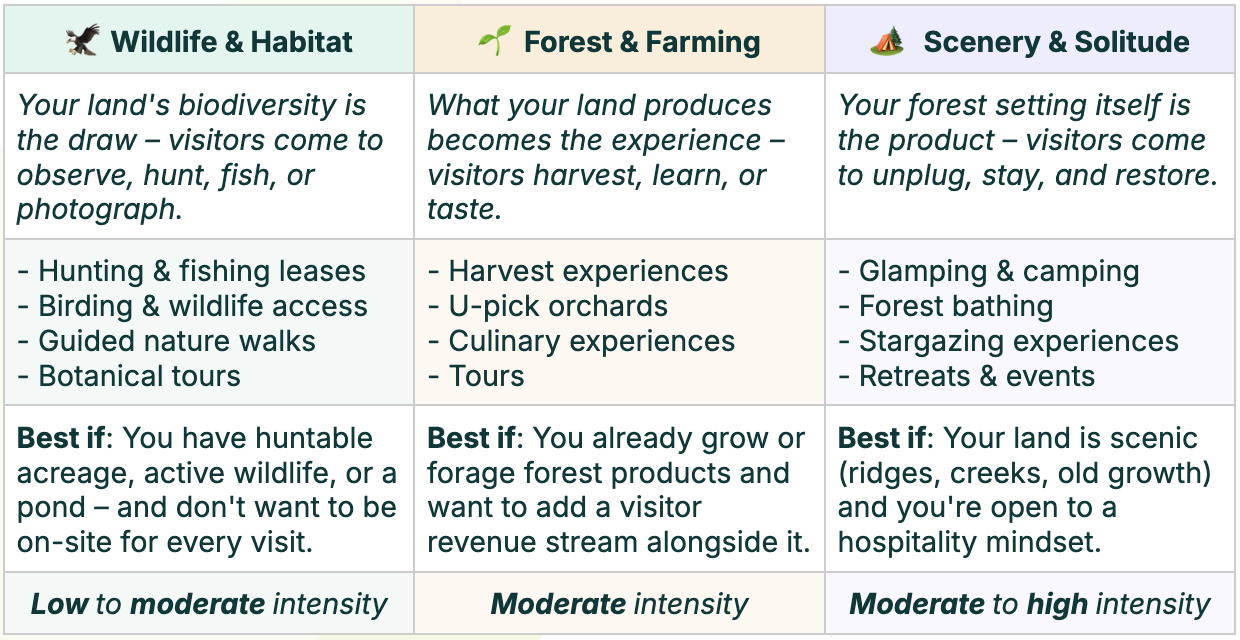
There's no one-size-fits-all model. Options range from low-effort (paid hunting access or u-pick harvests) to more involved (guided forest farming tours or glamping), so you can match the approach to your time, budget, and comfort level.
Your forest is already a destination. Ecotourism lets you profit from that without changing what your land fundamentally is.
Small acreage can still qualify. Even 50–200 acres of healthy, accessible forest can support meaningful income from land-based tourism, especially in Upstate New York where demand for outdoor recreation and local food experiences is growing fast.
Decision Factors
Recreational leasing is most compelling when your land already offers huntable acreage, harvestable forest products, or scenic features like ridges and creeks.
Willow & Vines
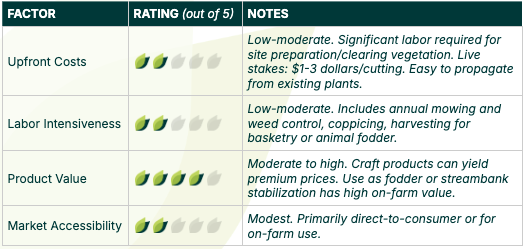
Willows are a group of fast-growing deciduous shrubs that root readily from dormant cutting placed in moist soil. When cut back, the plant regrows vigorously, producing long, straight shoots which makes it a valuable shrub for weaving and other crafts. Its tolerance for saturated soils also suits it to wet areas, streambanks, and erosion-prone ground.
Select a topic below to learn about starting and scaling a ecotourism enterprise on your land:
At a glance
Willow is one of the fastest-growing woody plants in the Northeast, established from low-cost cuttings in wet or marginal areas. It can be integrated into a wide range of vegetative buffers and plantings in riparian buffers, hedgerows, silvopasture, or alley cropping systems.
For small landowners, willow can be part of a harvestable vegetative buffer that serves the dual purposes of conservation and agricultural production. Land managers can use willow to:
Inexpensive and forgiving to establish: Willow roots easily from 10”-18” stakes planted directly into the soil. Willow can be easily propagated by taking cuttings from dormant, one-year old shoots.
Quick return on investment: Some willows can grow 3-8 feet within the first year of being planted. Willow can be harvested 1-3 years after planting, and coppiced or pollarded willows can remain productive for 20 or more years.
Decision Factors
Saffron
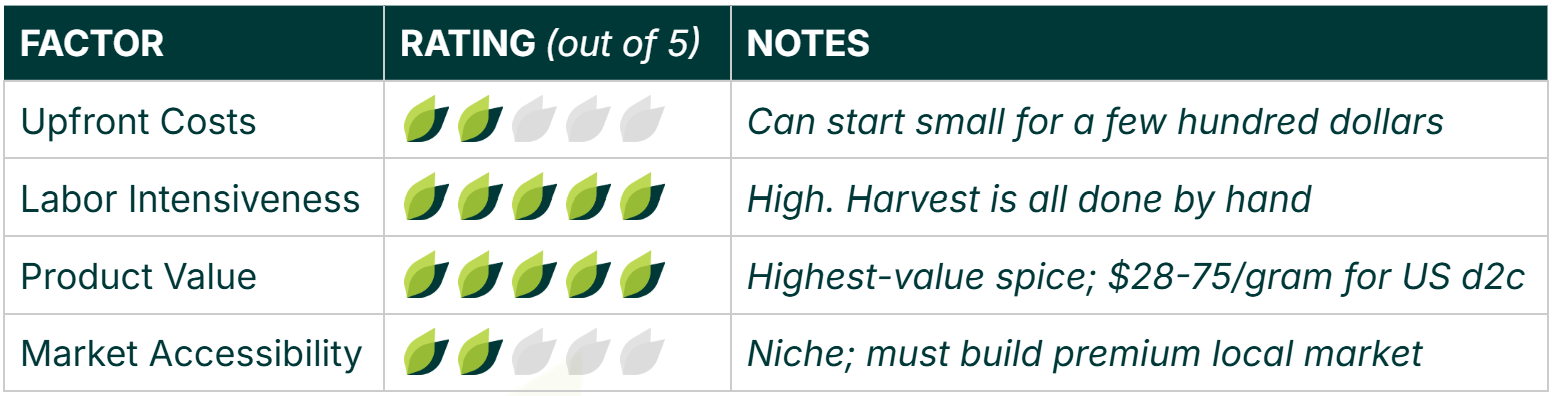
Saffron comes from the saffron crocus (Crocus sativus), a low, fall-blooming plant grown from small bulb-like corms. Each purple flower holds three slender red threads, called stigmas, that are picked and dried by hand to become saffron. It takes about 150 flowers to yield a single gram. Saffron multiplies only underground, as each corm splits into new corms that you dig up and replant. It is prized for its deep color, honey-like aroma, and distinctive flavor. It is the most expensive culinary spice in the world.
Select a topic below to learn about starting and scaling a ecotourism enterprise on your land:
At a glance
Saffron is the world's most valuable spice by weight. It comprises the dried red threads (the stigmas) from inside a fall-blooming crocus flower; it takes roughly 150 flowers to make a single gram.
Saffron operations can easily scale down. A small garden bed can work, but labor requirements can be intensive as harvest is all done by hand.
Best suited as a supplemental or value-added income. Smaller growers often categorize it as a passion crop, and is often best suited for growers who already have direct market connections and abundant time or labor on their hands.
Decision Factors
Market Directory
The following directory and map are additional resources for landowners looking to double-click into any of the emerging markets covered on this page. The resources listed are not exhaustive, but represent a strong sampling of the information most relevant to small forest landowners in the Northeast. The accompanying interactive map allows landowners to visualize where active market players and providers are located relative to them, helping connect opportunities to physical resources nearby.
| Market | Resource Type | Name | Summary |
|---|---|---|---|
| Ecotourism | Budget | Using Alternative Enterprises and Recreational Development to Bolster Farm Incomes | A workbook that helps farmers and landowners explore and plan agritourism and recreational enterprises, weighing income potential, risk factors, regulatory issues, and operational considerations. Contains worksheets, checklists, sample business models, and discussion prompts to guide decision-making about different agritourism activities (e.g. farm tours, lodging, U-pick, events). |
| Ecotourism | Implementation | Cornell's FAQ: Agritourism on Your Farm | An FAQ and guidance document aimed at farmers considering adding agritourism to their operations, focusing on legal, financial, safety, and regulatory issues. Discusses zoning and land use, employment and labor laws, taxes and accounting, liability and insurance, sales tax, and accessibility and ADA compliance. |
| Ecotourism | Implementation | Getting Started in Agritourism | A guide on beginning agritourism operations — how to plan, launch, manage, and market agritourism attractions. Includes idea generation, planning, visitor experiences, visitor area design and facility standards, liability insurance and risk management, marketing and audience targeting, and operational tips. |
| Ecotourism | Implementation | Creating Successful Agritourism Activities for Your Farm (CISA/BuyLocalFood) | A workbook and planning guide to help farmers develop or refine agritourism operations. Includes business planning tools, activity idea generation, market and visitor analysis, operations and infrastructure, financial estimates and budgeting, risk, liability and insurance, marketing and promotion, and additional resources. |
| Ecotourism | Implementation | National Agricultural Law Center: States' Recreational Use Statutes | All 50 states have enacted statutes that confer some degree of liability protection to landowners who allow the general public to enter their land for recreational purposes. Commonly referred to as "recreational use statutes," these laws promote the public policy of encouraging landowners to open their lands so the public may access a wider range of recreational activities. |
| Ecotourism | Implementation | Nature of Agritourism: Legal Risk Management for Agritourism Operators | A slide deck explaining legal issues and risk management strategies specific to agritourism, focusing on landowner liability, premises law, and business structuring to reduce exposure. Breaks down negligence and premises liability, distinguishes between types of entrants (trespasser, licensee, invitee) and their corresponding liability obligations, and presents business structure options (sole proprietorship, LLC, corporation, etc.) and how they can protect personal assets. |
| Ecotourism | Implementation | USDA National Agricultural Library: Agritourism | A landing page that provides an overview of agritourism (combining farming and visitor activities), defines core concepts, and links to tools, guides, and resources relevant for agritourism development. Offers links to resources on agritainment, growing your brand, and more. |
| Ecotourism | Implementation | Agritourism Best Practices Guides (NIFA Local Food and Agritourism) | A collection of curated guides presenting recommended practices for agritourism operators, covering insurance, risk management, operations, marketing, guest experience, and safety. Topics include collaborating to strengthen your agritourism enterprise, hospitality and creating a positive visitor experience, location, your visitors, risk management, and marketing basics. |
| Ecotourism | Implementation | Insights on Agritourism Among US Producers: Evidence from the 2024 National Agritourism Producer Survey | This report presents findings from a 2024 online survey of 2,139 U.S. agritourism operators to understand producers' challenges, motivations, business practices, and support needs. Provides quantitative insights into types of agritourism operations, revenue diversification, barriers (e.g. regulatory, infrastructure), and trends. Includes regional and state-level breakdowns to highlight variation across geographies. |
| Ecotourism | Implementation | Integrating Safety into Agritourism | A toolshed of practical tools, interactive walkthroughs, and checklists to help farm operators identify hazards and implement safety best practices so they can host visitors more safely and reduce liability. Topics include machine safety, large animals, water hazards, fencing, emergency planning, and food safety. |
| Ecotourism | Implementation | Roots to Revenue: Making Agritourism Work for Your Farm | A publication that walks farmers through launching or improving an agritourism enterprise, covering strategic and operational considerations. Highlights benefits, risk management, business planning, regulations, marketing, and case studies. Covers liability and safety considerations, pricing, and seasonal programming for agritourism ventures. |
| Ecotourism | Implementation | Agricultural Marketing Resource Center: Agritourism | A landing page with multiple resources including information on opening a farm store, hosting tours, value-added products, pick-your-own, entertainment, on-farm events, and overnight stays. |
| Ecotourism | Training | Farm-Based Education Network | Offers programs aimed at supporting farm-based educators (farmers, schools, nonprofits) to develop experiential learning activities on farms and gardens. Offerings facilitate peer learning, site visits, workshops, and capacity building. |
| Ecotourism | Market | WWOOF USA (Worldwide Opportunities on Organic Farms) | Connects volunteers ("WWOOFers") with organic farms in the U.S. to facilitate hands-on learning in organic agriculture and sustainable practices. In exchange for helping with farm tasks, volunteers typically receive food and lodging. Maintains a directory of host farms open to volunteers, showing the farm's practices, location, and what the host offers and expects. |
| Ecotourism | Market | Hipcamp | Online marketplace for nature stays (camping, glamping, RV, cabins) — a "camping Airbnb" that connects landowners with guests. Hosts can list tent sites, RV spots, glamping units, cabins, or other lodging and gain visibility to Hipcamp's user base searching for nature stays. |
| Ecotourism | Market | Harvest Hosts | A marketplace, membership program, and marketing platform that connects landowning businesses (such as farms, wineries, breweries, and attractions) with RV travelers seeking unique overnight stays. |
| Ecotourism | Market | Airbnb | Enables landowners or farmers to earn income by offering lodging (cabins, tiny homes, glamping, guest houses, etc.) or Experiences — guided tours, workshops, farm stays, etc. — on their property. Hosts must meet local regulations including zoning, permits, and liability insurance, and are subject to Airbnb's safety and quality standards. |
| Ecotourism | Network | Local Harvest | A national directory of over 40,000 farms, markets, and food producers, which consumers can search by location and product type. Connects consumers with local farms, farmers markets, CSAs, and local food producers by providing a searchable directory and marketplace, helping to strengthen local food systems and support small farms. |
| Ecotourism | Network | North American Farmers' Direct Marketing Association / International Agritourism Association (NAFDMA) | A membership-based trade and industry association supporting direct marketing and agritourism operations. Membership benefits include access to webinars, an education center, member directory, podcasts, and supplier and industry connections. Also hosts the Agritourism Convention & Expo. |
| Willow & Vines | Implementation | A Beginner's Guide to Willow Basketry | A grower's step-by-step guide to producing and preparing willow for basket weaving. |
| Willow & Vines | Implementation | Living Willow Structures by Bonnie Gale | A design studio for custom living willow structures, with workshops and a how-to book. |
| Willow & Vines | Implementation | 'Streamco' Purpleosier Willow | USDA release brochure for a shrub willow cultivar used mainly for streambank stabilization. |
| Willow & Vines | Implementation | USDA NRCS Big Flats Plant Materials Center | The federal center that develops and releases conservation plants for the Northeast. |
| Willow & Vines | Network | SUNY ESF – The Willow Biomass Project | ESF's research program on shrub willow as a renewable biomass and conservation crop. |
| Saffron | Implementation | Martha Stewart Guide to Saffron Production | A photo-essay on planting and harvesting saffron at a New York farm. |
| Saffron | Implementation | Saffron: A Tale of Red Gold and How to Produce Your Own | A Penn State Extension overview of saffron history and small-scale production. |
| Saffron | Implementation | Saffron A Good Fit for New England | A MOFGA summary of UVM research on saffron as a Northeast diversification crop. |
| Saffron | Implementation | Saffron Growing Resources & Information | UVM's library of saffron factsheets, presentations, and research. |
| Saffron | Budget | Saffron Enterprise Budget | A UVM Excel tool for estimating saffron production costs and returns. |
Stakeholder Landscape
The stakeholder maps provide a consolidated resource identifying the key programs, buyers, service providers, and organizations operating in each emerging forest market. Rather than piecing together information from dozens of sources, landowners and partners can find regional information in one place.